 Nafisa
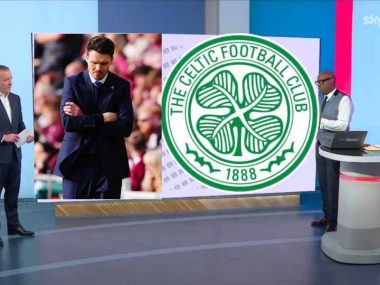
Kim Milton Neilsen, the former World Cup semi-final and Champions League final referee, has described John Beaton’s late Celtic penalty call as a “loser decision” and called for Scottish football to abandon VAR in order to reduce the unbearable pressure placed on top-level match officials.
Neilsen spent more than 20 years officiating at the highest level of both club and international football and is well used to controversy erupting after contentious calls.
The Dane famously sent England midfielder David Beckham off for kicking his Argentine opponent Diego Simeone in the last 16 of France ’98 – a decision that led to the Manchester United star being heavily criticised in his home country.
Because of that experience, he has expressed sympathy for Beaton, who awarded Celtic an injury-time penalty that Kelechi Iheanacho converted to secure an unlikely 3-2 win in their penultimate William Hill Premiership match against Motherwell at Fir Park last night, in the midst of the ongoing debate across Scottish football.
Derek McInnes, whose Hearts side now require just a draw against their closest rivals at Parkhead on Saturday to be crowned Scottish champions for the first time in 66 years, labelled the decision “disgusting”, while former Category 1 referees such as Bobby Madden and Steve Conroy have also openly disagreed with their ex-colleague.
However, Neilsen argued that Beaton would have faced equally fierce criticism had he refused to award the defending champions a penalty, given the timing of the Sam Nicholson handball incident and the massive significance of the result at such a decisive moment in one of the tightest title races in recent memory.
In his view, the issue lies with the introduction of technology rather than the referee’s ability.
“As a referee, you are alone,” he said. “You have two teams and every decision that you take will have the opposite meaning for the team that you are penalising whether you are right or wrong. Whenever that happens very late in the game, it becomes a very, very important decision.
“From the referee’s perspective, there’s no difference between a decision in the 97th minute or the first minute. But it becomes what I call a ‘loser decision’ at that stage of the game.
“If you award a penalty you will be blamed by one team and if you don’t you will be blamed by the other team. It’s always a very difficult situation, an impossible one in fact. When it happens at a crucial point in the season that gets multiplied tenfold.
“We have seen this across Europe recently. In English football last week we saw a decision in the Arsenal game against West Ham at the London Stadium (Callum Wilson had an injury-time equaliser for the relegation-threatened hosts disallowed after a VAR check and the Premier League leaders won) that changed the course of the title race.
“So there is a very large pressure for the referee to take a decision like that. It’s important when you are in the pitch not to think about what the result of your decision will be and to make what you think is a correct decision. Otherwise you will disturb yourself.
“If you think it will cause a row whenever you give a penalty it will mean that you will make very bad decisions. People have asked me many times if I thought about how much I could have cost a club when I gave a penalty in a Champions League, if I worried if it would result in the other team losing millions of pounds.
“But I would have been a very bad referee if I had allowed it to disturb my decisions. You have to make what you think is the right call regardless of what the consequences will be. As I say, sometimes you have loser decisions which will cause an argument whatever you do and this is one of them.”
Beaton was instructed to review the Nicholson incident on the pitchside monitor by VAR officials Andrew Dallas and Sean Carr after the ball went out for a throw-in – and Neilsen believes the referee should never have been put in that position.
The official who was given charge of the World Cup semi-final between Brazil and Turkey in 2002 by FIFA and the Champions League final between Porto and Monaco in 2002 by UEFA would prefer to see VAR removed from the SPFL altogether, arguing it has increased pressure on referees in Scotland.
“VAR has made the referee’s job far more difficult than it was before for me,” said Neilsen. “I’m very satisfied that I finished up before it was introduced.
“Keith Hackett (the former Premier League referee) said something about VAR once that I thought was spot on. He said you can see in the face of a referee when they enter the pitch if VAR is in use or not. He thought they were more relaxed when it wasn’t and looked under immediate pressure when it was.
“For many referees, having VAR is an added pressure because they have to think about it every time they do something. It disrupts their work. When it was introduced it was being used for a single decision every few games or so. Now, though, it’s being used in many situations during every match. It also takes a very long time to reach the decision.
“A referee has seen a situation and has made his decision. But suddenly he is then looking at pictures which show small details, maybe an arm in a different position or whatever, which he did not see at time. It is not football, not the meaning of football, for me.
“It is killing the enjoyment of the game. Players and fans don’t celebrate a goal like they did before because they are not sure if it will be allowed or disallowed. Even people who were supportive of VAR before it was introduced have turned against it now. I can understand why.
“It has destroyed football. It’s not as enjoyable a game now. It’s more like a video game if you ask me. I think countries like Scotland should consider getting rid of it. It would increase supporters’ enjoyment of the game and reduce the pressure for the referee as well.”
He continued, “The best referees in the world make mistakes. It’s impossible not to make mistakes. Your target when you go into the game is always to make no mistakes. But now referees will be forced in to making decisions for small things which are not important for the game by VAR. Of course they will make mistakes.
“Before VAR came in there was always discussion after the game about mistakes by a referee. But now we have a lot more discussion than before because people have watched the video clips the referee saw in the heat of the moment a lot of times afterwards and have a different opinion about that.”
Scottish football fans were unsurprised when no referees from this country were selected by FIFA for the World Cup in Canada, Mexico and the United States this summer.
But Neilsen, who was involved at Euro ’96, France ’98, Euro 2000 and Japan and South Korea 2002, believes it is now far more difficult for officials from smaller nations to reach major tournaments in the modern game.
“We haven’t had any Danish referees at the World Cup since I retired 20 years ago,” he said. “We have the same problem here that Scotland have. It is tough because the bigger nations have a lot more referees and a lot more big games where they are under a lot more pressure.”


 Nafisa