 Nafisa
Celtic have attempted to take another step towards improving communication with their supporters, but the club’s latest announcement has instead triggered a wave of criticism, with fans questioning whether the board is serious about listening to them.
With the club’s Annual General Meeting fast approaching, an official statement published on November 9 introduced a new supporter engagement initiative called Celtic Connect. The scheme is designed to give fans a formal platform to discuss important issues directly with senior figures at the club.
However, rather than welcoming the announcement, a section of the support immediately turned their attention to one particular detail of the proposal. The criticism quickly spread across social media, with supporters questioning why the rules being introduced for the new fan group do not appear to apply to members of the board.
The timing has only added to the reaction, with Celtic preparing for an AGM that is expected to bring further scrutiny of the club’s leadership.
Celtic Connect is being presented as a structured forum that will bring together supporter representatives and senior club officials at least three to four times every season. Discussions are expected to cover a range of subjects, including the matchday experience, stadium developments, the club’s wider strategy, its heritage and supporter engagement.
The club has also promised that minutes and key updates from the meetings will be published, an arrangement intended to provide greater transparency about the discussions taking place.
The group will consist of 11 members, an increase from the original proposal of nine following feedback. Its membership is intended to represent different sections of the Celtic support, including season-ticket holders from across the stadium, a match-attending supporter without a season ticket, Celtic FC Women, international supporters, shareholders and the club’s equality, diversity and inclusion community.
There will also be a joint-chair arrangement, with a supporter co-chair elected annually alongside Celtic’s Head of Supporter Engagement.
But it is the proposed membership rotation that has become the biggest talking point.
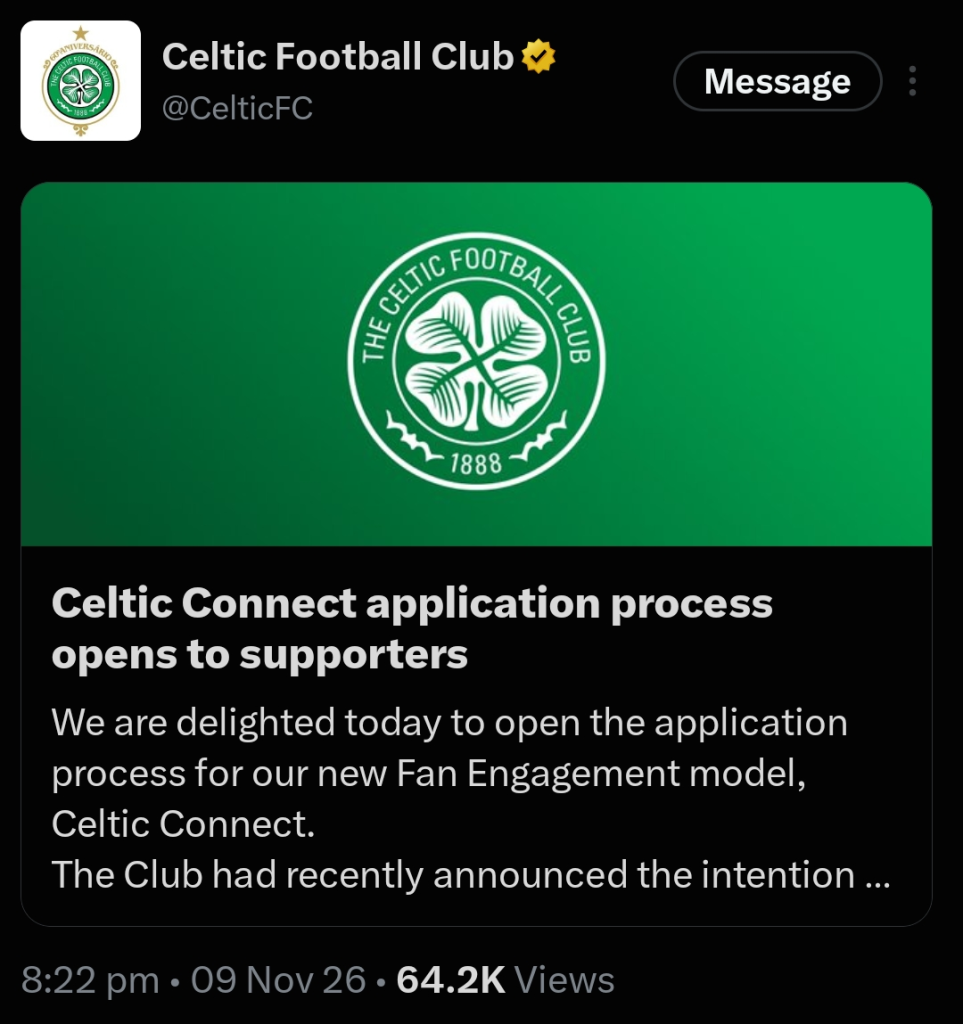
Under the new arrangement, Celtic Connect will operate a three-year rolling membership, meaning a third of the group will change each year. The club says this is intended “to ensure fresh voices but also continuity.”
For supporters already frustrated with the length of time some directors have remained in their positions, that explanation has not gone down particularly well.
One widely liked response to Celtic’s announcement questioned the apparent difference between the rules for the supporter group and those governing the board.
“How come the membership of this group will change on a rolling 3 yearly basis but certain members of The Board have been there for 10+ years? Contrary to best practice.”
Another supporter raised the same issue, questioning why a three-year rotation was being introduced for fan representatives when similar expectations were not being applied to directors.
Other reactions were even more dismissive, with some fans suggesting the initiative was designed to reduce the criticism expected at the upcoming AGM rather than address the deeper concerns surrounding the club’s leadership.
One comment described it as an attempt to “soften up the criticism that will be coming up at the AGM”, while another simply responded: “Nobody gives a fuck.”
Those reactions reflect the wider frustration surrounding the relationship between sections of the Celtic support and the club’s board. For critics, creating another consultation group does not necessarily answer questions about accountability, transparency or the direction in which the club is heading.
The announcement also arrives at a particularly sensitive moment.
Celtic’s AGM is scheduled to take place at Celtic Park on Tuesday, December 1, at 12 noon. A separate General Meeting will be held at 9:30am to consider proposed amendments to the club’s Articles of Association, which have remained unchanged since 2011.
The proposed changes include provisions for hybrid or remote meetings in certain circumstances, removing the existing cap on the number of directors and making other governance adjustments.
Last year’s AGM ended prematurely amid protests and disruption, leaving the board facing continued questions from supporters and shareholders. This year’s meeting is expected to bring further scrutiny, including shareholder resolutions concerning strategic planning and an apology connected to events at the previous AGM.
Interim Chairman Brian Wilson and the club have previously emphasised shareholders’ right to challenge the board and ask difficult questions. Celtic Connect is now being introduced as another way of establishing dialogue between the club and its support.
However, the immediate response suggests that many supporters want more than another formal meeting structure. Their criticism is centred on whether the board is prepared to apply the same principles of renewal and accountability to itself that it is proposing for the new supporter group.
Applications for Celtic Connect are now open, and the club will hope the initiative can eventually improve relations between the boardroom and the stands.
For now, though, the reaction has been far from the welcome Celtic may have anticipated. With December’s AGM approaching, the argument over board accountability has already found another flashpoint.

 Nafisa