 Nafisa
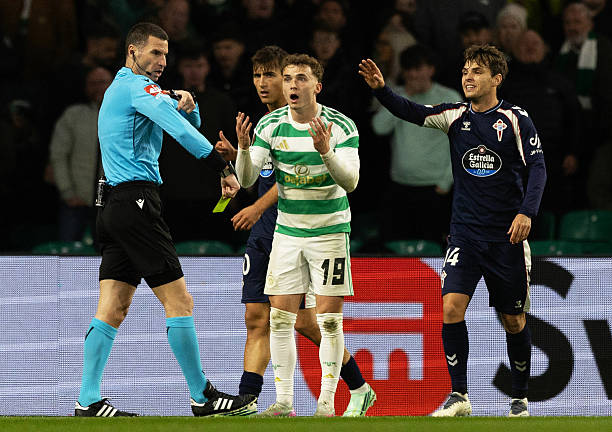
Celtic’s devastating 2-1 defeat to Celta Vigo has put referee Georgi Kabakov under the spotlight, with three contentious incidents leaving Martin O’Neill furious and supporters questioning how the Bulgarian official was allowed to oversee such an important Europa League fixture.
The Hoops had taken the lead through Mika Baur early in the second half, putting themselves in a promising position to claim their first points of the European campaign. Instead, two goals from Javi Rodriguez turned the match around, leaving Celtic empty-handed for the third consecutive Europa League game.
But while Celtic must take responsibility for failing to protect their advantage, the decisions made by Kabakov have become a major talking point. O’Neill believed his side should have received a free-kick before Celta’s equaliser, while an earlier incident involving Callum Osmand also generated fierce debate after a penalty appeal was rejected.
What makes the controversy even more striking is Kabakov’s recent record in Bulgaria, where he was handed an indefinite suspension following a disputed VAR decision in October 2025.
Just months later, his involvement in another contentious incident prompted the president of the Bulgarian Football Union to publicly call for his appointments to be reconsidered.
That history does not automatically prove Celtic were wronged at Parkhead. However, it raises an uncomfortable question: given the scrutiny surrounding Kabakov over the previous 12 months, should UEFA have considered that record before appointing him to a match of such importance?
THREE FLASHPOINTS THAT LEFT CELTIC FUMING
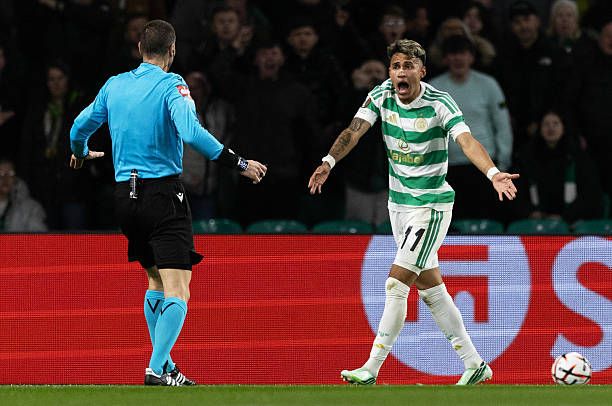
The first major incident involved Camilo Durán, with Celtic believing the forward had been fouled without receiving a free-kick.
The decision became particularly significant because O’Neill felt his side had been denied an opportunity to retain possession before the referee awarded Celta a free-kick shortly afterwards.
The Celtic manager made his frustration clear when discussing the sequence that preceded the Spanish side’s equaliser.
“We conceded a free-kick. I thought, just seconds before that, that we had a foul for us.
“Referee’s disowned that and given them a foul about 10 seconds later and they scored from the free-kick.”
O’Neill returned to the Durán incident when explaining why he was unhappy with the officiating.
“Apparently, first of all, I thought there was a foul in the first half against Camilo and they said that VAR were checking it.
“I don’t know what we’re looking at because it was a very obvious foul.”
The second flashpoint came when Kabakov awarded Celta a free-kick following a challenge involving Liam Scales. Celtic believed the decision should have gone their way, particularly given the earlier incident involving Durán.
Instead, Celta were presented with a set-piece opportunity, and Rodriguez took advantage to level the score. The visitors then struck again minutes later, turning a match Celtic had been leading into another damaging European defeat.
It cannot be proved that a different decision would have prevented either goal. Celta still had to execute the set-piece, and Celtic still had to defend it. Nevertheless, the timing of the decision made it a defining moment in the match.
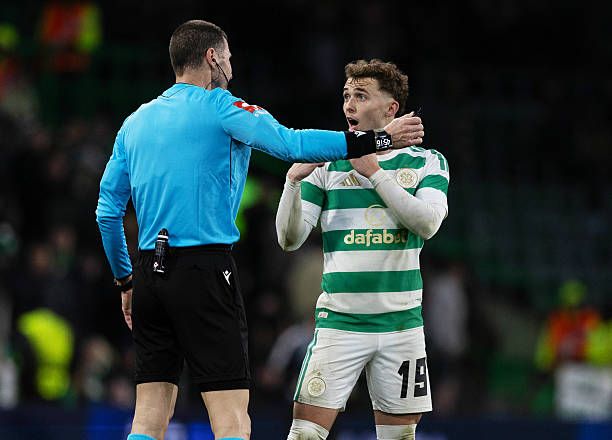
The third controversy concerned Callum Osmand, who went down during a challenge involving Celta defender Javi Rueda as he advanced towards the penalty area.
Kabakov waved play on, and VAR did not intervene. Celtic were left without a penalty, while pundits questioned why the incident had not been punished.
Stiliyan Petrov was particularly critical of the decision.
“I just don’t know how he (Kabakov) hasn’t seen it. There are a lot of questions about Kabakov as he has only refereed four games in the Bulgarian League and six in the Europa League.
“I don’t know what UEFA are looking into (when they pick referees) but you need to have the consistency to make a decision.
“(The foul) is probably outside the box but can they even look at it being a red card? Osmand is going through and I think it’s a really, really poor decision.”
Neil Lennon also struggled to understand why Celtic had not been awarded a penalty or a free-kick.
“That is beyond me that (why it’s not a penalty). It’s either a foul outside the box or a penalty.
“Why does he (Osmand) go down? He doesn’t need to. He is going straight into the box and there is definitely contact, we can see it from up here in the gantry. I don’t know what the referee is seeing. Any touch at all can bring you down sometimes as you lose balance.”
Craig Halkett added:
“He (the defender) was obviously trying to put Osmand off but I think there was more than a little bit of contact there.
“You can see the push when Osmand is running through on goal. He has no other reason to go down so I think the defender is really lucky to get away with that.”
The precise reason Kabakov rejected the appeal is not known. Furthermore, if a foul begins outside the penalty area, the appropriate punishment would normally be a direct free-kick rather than a penalty. But the absence of any VAR intervention ensured the incident became another source of frustration for Celtic.
THE SUSPENSION THAT PUT KABAKOV UNDER SCRUTINY
The events at Celtic Park become more contentious when placed alongside Kabakov’s recent disciplinary history.
On October 7, 2025, the Bulgarian Football Union’s refereeing committee announced that Kabakov and fellow official Vladimir Valkov had been suspended indefinitely following their performance as VAR officials during a Bulgarian league match between Slavia Sofia and Lokomotiv Sofia. The federation cited their unsatisfactory performance.
The controversy centred on Slavia’s opening goal. Martin Georgiev handled the ball with both hands before providing the assist for Emil Stoev, yet the goal was allowed to stand. Kabakov and Valkov were in the VAR team but did not intervene to recommend a review.
Slavia went on to win 2-0, with the disputed goal becoming the focus of the subsequent disciplinary action.
For an official regularly entrusted with major domestic and European matches, an indefinite suspension was a serious setback. It was not simply a disagreement over a marginal challenge: the punishment followed a VAR performance that the Bulgarian authorities formally deemed unsatisfactory.
Kabakov’s suspension was lifted within approximately a month, and he returned to domestic refereeing in November 2025. UEFA also continued to appoint him to European matches.
That return demonstrated that the domestic punishment did not end his international career. However, it also meant his subsequent performances would be judged against the background of the earlier controversy.
ANOTHER CONTROVERSY IN APRIL 2026
The October suspension was not the last time Kabakov faced scrutiny.
In April 2026, another disputed VAR decision involving a penalty appeal during the Bulgarian league match between Beroe and CSKA Sofia prompted further criticism. The Bulgarian Football Union’s president, Georgi Ivanov, publicly disagreed with the explanation given by the refereeing committee and called for Kabakov’s involvement in matches for the remainder of the season to be reconsidered.
Ivanov’s intervention was significant because it brought criticism from the head of the national football association into an already heated refereeing debate. The issue was no longer confined to supporters complaining about an isolated decision; questions were being raised at the highest level of Bulgarian football about the handling of controversial calls.
Reports at the time also highlighted Kabakov’s earlier suspension and the possibility of another prolonged period away from domestic appointments.
That is the context in which Celtic supporters are now examining his performance against Celta Vigo. Within the space of roughly a year, Kabakov had been suspended over a VAR error and become the subject of another public call for his appointments to be reviewed.
It would be unfair to conclude that his previous controversies automatically make every subsequent decision incorrect. Referees can make good decisions after poor performances, and a disputed call is not proof of bias. But his recent record makes it reasonable to scrutinise the decisions made on Thursday rather than dismissing the criticism as nothing more than Celtic frustration after a defeat.
SHOULD UEFA HAVE APPOINTED HIM FOR SUCH A BIG GAME?
This is where the debate becomes uncomfortable for UEFA.
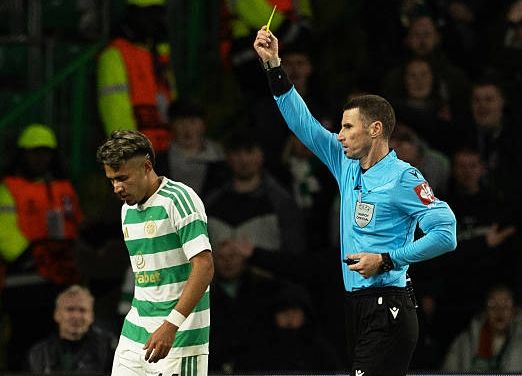
Kabakov was appointed to Celtic’s Europa League clash despite the disciplinary action he had faced in Bulgaria and the renewed controversy surrounding his VAR work earlier in 2026. UEFA clearly continued to trust him with major fixtures, and his appointment was not, by itself, evidence of wrongdoing.
Indeed, he had been given another prominent European assignment shortly before the Celtic match. The decision to appoint him again suggested that UEFA remained satisfied with his work at that level.
Nevertheless, Celtic’s match was far from insignificant. The Scottish club desperately needed a result after defeats against Ferencváros and Benfica, and the loss to Celta Vigo left them with three defeats from their opening three Europa League games.
Against that backdrop, the standard of officiating mattered enormously. The Durán incident, the free-kick awarded against Scales and the Osmand penalty appeal all became major talking points because they occurred at crucial moments in a match Celtic ultimately lost.
The argument that UEFA should have been more cautious with Kabakov’s appointment is therefore understandable. His recent history gave the governing body reason to be aware that his officiating had already attracted serious criticism and disciplinary consequences in his home country.
That does not establish that another referee would have made different decisions, nor does it prove that Kabakov deliberately favoured Celta Vigo. But it does raise a legitimate question about the assessment process used when selecting officials for high-pressure European matches.
CELTIC HAVE REASONS TO BE ANGRY — BUT THE DEBATE WILL CONTINUE
O’Neill did not hide his displeasure with Kabakov’s performance, saying:
“I didn’t think it was one of his best games, to be perfectly honest, but we’ve got beaten in the game.”
That final admission is important. Celtic cannot blame the referee for everything that went wrong. They had chances to extend their lead, including Liam Scales hitting the woodwork, and ultimately failed to stop Celta’s comeback.
Yet the officiating controversy will not disappear simply because Celtic also made mistakes.
The three flashpoints, combined with Kabakov’s recent history of suspension and renewed scrutiny in Bulgaria, have created a wider debate about whether the referee should have been entrusted with this fixture.
For Celtic supporters, the concern is straightforward: their team needed a result, several key decisions went against them, and the official responsible had already endured a turbulent 12 months.
Whether those calls ultimately cost Celtic the match cannot be proven. But with their Europa League campaign now in serious trouble, the questions surrounding Kabakov’s performance — and UEFA’s decision to appoint him — are unlikely to go away.

 Nafisa