 Nafisa
Lawrence Shankland injury blow as Derek McInnes admits Rangers star could face lengthy absence after Motherwell win
Rangers’ 1-0 victory over Motherwell at Ibrox came at a heavy potential cost, with the result overshadowed by a worrying early injury to Lawrence Shankland.
The Scotland international had only just begun to find his rhythm in a Rangers shirt after arriving from Hearts as a free agent during the summer, making his latest setback particularly frustrating.
Shankland had scored three goals across his previous two appearances and appeared to be growing into an increasingly important attacking role for Derek McInnes.
But his afternoon at Ibrox lasted only a matter of minutes.
The striker was forced off early in the contest, with Ryan Naderi coming on in his place. Naderi would eventually provide the decisive moment by scoring the only goal of the game, but Rangers’ attention afterwards was understandably focused on the condition of their captain.
McInnes’ assessment did little to ease those concerns.
Worst-case scenario laid out for Lawrence Shankland
Shankland missed a few months of last season with a hamstring problem while at Hearts, making the nature of Saturday’s injury particularly concerning.
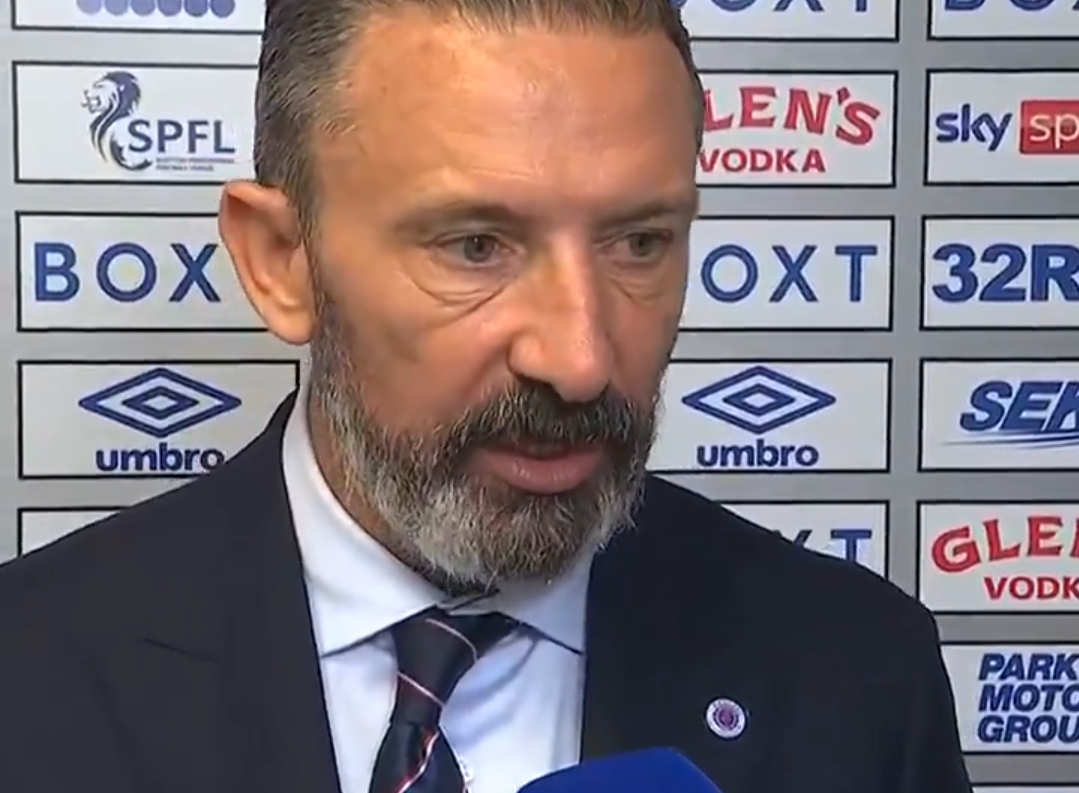
McInnes, who is already without Youssef Chermiti for the season, shared another update on the 31-year-old’s injury to reporters after the game.
“Lawrence said he has a similar feeling to the hamstring injury he had at Hearts last January when he was out for three months,” McInnes said.
“Obviously we don’t want to speculate too much. But he says it feels similar to in the same area, so we’ll get him scanned on Monday.”
That immediately raises the possibility of a significant absence for Rangers.
Nothing has been confirmed until Shankland undergoes his scan, and McInnes was careful not to put a definitive timescale on the problem.
However, if the striker’s latest injury does prove comparable to the hamstring issue that previously kept him out for around three months, Rangers could be forced to cope without one of their most in-form attackers for a substantial portion of the opening months of the campaign.
That would be particularly painful given the timing.
Shankland had finally begun to deliver the goals Rangers had hoped for when they brought him to Ibrox, scoring three times in his previous two matches.
A lengthy layoff would therefore interrupt his momentum just as he was starting to establish himself.
It would also deprive McInnes of his captain for a potentially crucial run of fixtures.
Shankland is facing a race against time to return for the upcoming Old Firm clash with Celtic, while Rangers also have league meetings with Kilmarnock, Dundee, St Johnstone, Hearts, Aberdeen, St Mirren, Motherwell, Dundee United, Falkirk and Hibernian during the period in which he could potentially be sidelined.
The exact number of games he misses will depend entirely on the eventual diagnosis and recovery timeline.
But there is no question that Rangers would feel his absence.
Could Falkirk be to blame for Shankland injury layoff?
One particularly interesting detail surrounding Shankland’s injury is that it occurred off the ball against Motherwell.
There was no obvious collision or heavy challenge that immediately explained the problem. Instead, the striker felt something pull in his hamstring area and was subsequently forced to leave the field.
That has naturally led to questions over whether the demands of Rangers’ schedule and playing surfaces could have contributed.
McInnes pointed towards Wednesday night’s trip to Falkirk, where Rangers had played on a 4G surface just days before returning to Ibrox.
“You know, his output was really high on Wednesday at Falkirk on the 4G pitch,” McInnes said.
“Sometimes going that from pitch to pitch, the different surface can make you a wee bit more vulnerable.
“But he says he felt fine going into the game, so, and there was nothing really that he did in the game that he was aware of, he just felt it pull up.”
The Rangers boss did not claim that Falkirk’s surface caused the injury, but the comments underline the difficulty players can face when moving between different playing surfaces during a busy schedule.
For Shankland, the timing could hardly be worse.
The 31-year-old had been building confidence, finding the net regularly and looking increasingly dangerous in Rangers’ attack. Now, he faces the uncertainty of another scan and potentially another lengthy period on the sidelines.
Rangers can at least take some comfort from the fact that Naderi immediately stepped into the breach and produced the winning goal against Motherwell.
Kevin Kelsy, Kim Minsu and Bojan Miovski also provide McInnes with alternative attacking options, although replacing Shankland’s goals and leadership will be a considerable challenge if the worst-case scenario materialises.
For now, Rangers must wait for the scan.
But after Shankland’s previous hamstring problems, McInnes’ comparison to an injury that kept him out for three months has given the Ibrox support plenty of reason to worry.
A player who had finally started to find his feet at Rangers could now be facing another frustrating spell watching from the sidelines.

 Nafisa