 Nafisa
The Scottish Football Association could face growing questions over one of the biggest talking points from Rangers’ Premier Sports Cup semi-final victory over Aberdeen at Hampden.
While the match produced plenty of drama, attention has continued to centre on a controversial incident inside the Rangers penalty area, with Aberdeen players and supporters left frustrated after their appeals for a spot-kick were rejected.
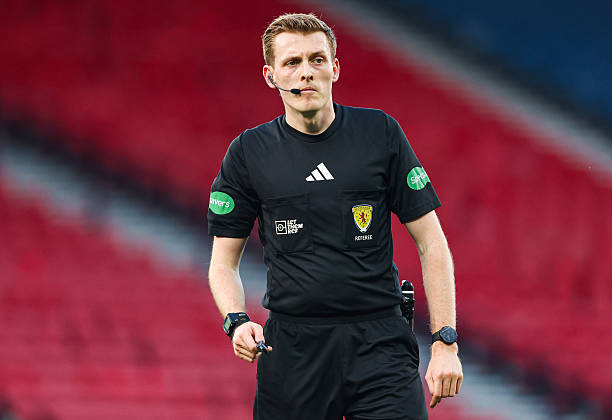
The incident involved Dujon Sterling, who missed an attempted header before the ball struck his arm inside the box. Referee Ryan Lee allowed play to continue, while VAR official John Beaton did not recommend an on-field review.
The decision has since attracted criticism, with questions being raised about whether Aberdeen should have been awarded a penalty.
What the SFA could say about Sterling’s handball
Any anticipated explanation from the Scottish FA would likely focus on the position of Sterling’s arm and the circumstances surrounding the contact.
The governing body could argue that the Rangers defender was attempting to challenge for the ball in the air and that his arm was in a natural position as he tried to compete for the header.
Under that interpretation, the contact would not automatically constitute a handball offence simply because the ball struck his arm inside the penalty area.
A possible explanation read:
“The incident was reviewed by VAR, with consideration given to the position of the defender’s arm and the circumstances in which the ball made contact with it. The defender’s arm was considered to be in a natural position as he attempted to challenge for the ball. VAR did not identify a clear and obvious error in the referee’s on-field decision not to award a penalty.”
Such an explanation would suggest that the officials believed Sterling’s arm position did not justify a penalty and that there was insufficient reason for VAR to intervene.
However, this remains a hypothetical reconstruction of what an explanation might look like, not an official statement issued by the Scottish FA.
Why the natural arm position could become central
The position of Sterling’s arm is likely to be the most important aspect of any potential explanation.
Defenders naturally use their arms to maintain balance and generate elevation when attempting to challenge for aerial balls. The question is whether the position of the arm in a particular incident is considered justifiable or whether it makes the player liable for a handball offence.
That distinction could form the basis of the SFA’s defence of the decision if it chooses to address the incident.
The fact that Sterling missed the ball with his head before it struck his forearm could also feature in the discussion, although that alone would not automatically determine whether a penalty should have been awarded.
The officials would ultimately have needed to assess the circumstances of the contact, including the position of the arm and whether it was considered to have made the defender’s body unnaturally bigger.
Aberdeen’s penalty appeal remains controversial
The decision has attracted different interpretations, making it difficult to dismiss the frustration surrounding Aberdeen’s unsuccessful appeal.
Sky Sports pundit Michael Stewart was particularly critical of the decision, pointing to the fact that Sterling missed the ball with his head before it struck his forearm.
Former Aberdeen defender Andy Considine offered a more measured assessment, acknowledging that players need their arms to jump but admitting that similar incidents have resulted in penalties.
Those differing opinions illustrate why the incident has continued to generate discussion.
For Aberdeen supporters, the central frustration is that the ball clearly made contact with Sterling’s arm inside the penalty area, yet their team was not awarded the opportunity to take a spot-kick.
For Rangers, the decision ultimately went in their favour as they secured a 1-0 victory through Ryan Naderi’s late goal.
Until the Scottish FA provides an official explanation, however, any suggestion that the governing body has confirmed the reasoning behind the decision would be premature.
If an explanation does emerge, the natural position of Sterling’s arm and the circumstances of the aerial challenge are likely to be central to the discussion.

 Nafisa