There are weekends in a title race that feel normal at the time… but refuse to stay that way once the dust settles.
For Celtic, it was another one of those afternoons where the job itself was done. Three points were secured, the pressure stayed alive, and the chase at the top of the Scottish Premiership continued.
But while their attention stayed locked on their own performance, something unfolding elsewhere has now pulled the spotlight firmly in another direction.
Because what happened at Tynecastle is now being talked about far beyond the 90 minutes it was played.
And it is not going away.
The match between Hearts and Motherwell was already tight. A game that never quite settled, never fully belonged to either side. At 1-1 heading into the closing stages, it felt like one moment could decide everything.
That moment came in the 88th minute.
Inside the box, a high ball dropped into a crowded area. Stephen Welsh attempted to deal with it. Landry Kabore went down in the challenge. The referee initially waved play on.
For a brief moment, nothing happened.
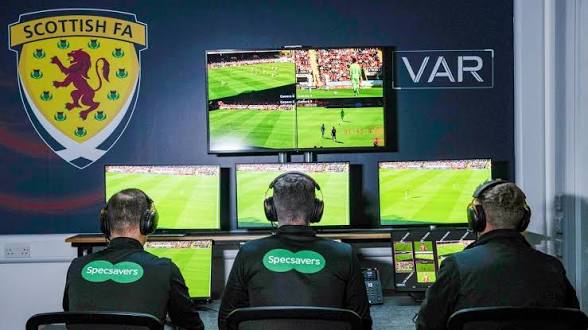
Then VAR stepped in.
And everything changed.
The on-field referee Matthew MacDermid was instructed to review the incident by Steven McLean in the VAR room. After the check, the decision was overturned.
Penalty Hearts.
Lawrence Shankland did what he so often does in those moments, converting from the spot to swing the game firmly in Hearts’ favour. Kabore would later add another goal as Hearts closed out a 3-1 win that felt very different depending on which side of the decision you were on.
Because almost immediately, the controversy began to build.
And this is where the debate escalated beyond usual post-match frustration.
Former officials speaking through The Ref’s View podcast delivered a strong verdict on the decision. Their interpretation of the laws of the game was blunt.
“Based on this, laws of the game say no penalty.”
They pointed directly to guidance from the International Football Association Board, stating:
“Playing in a dangerous manner is any action that, while trying to play the ball, threatens injury to someone (including the player themself)”
Their conclusion left little room for ambiguity.
“Not a penalty. Hearts player has endangered himself with trying to head the ball in the box, the defender is trying to clear the ball which he is entitled to do. Absolutely unfair for him to be punished for that.”
That word again.
Unfair.
And it is the word that has now defined the entire discussion.
Motherwell manager Jens Berthel Askou was visibly frustrated after the game, feeling the turning point had come in the most painful possible manner for his side. What had been a competitive match suddenly swung on an incident that left them with nothing to show for their effort.
Because that is the reality of moments like this.
They do not just influence games. They decide them.
Yet not everyone saw it through the same lens.
Former Hearts striker and manager Steven Naismith offered a contrasting view, backing the decision after a second look at the incident.
“First viewing of it, I thought it’s not a penalty.”
But his opinion shifted after reviewing the replay.
“But, when you see the replay, it’s like a striker getting to the ball first – whether it’s with his foot, his head or whatever, if he gets there first and the defender makes contact then it’s a penalty.
“I think the bit that makes it a bit strange is Kabore’s position – he is lying flat on his back, but he does get his head on the ball. For me, it’s a penalty.”
Two completely different readings of the same moment.
And that is exactly why it has exploded into wider debate.
Now, with the fallout still being discussed, the impact on the title race is where attention inevitably turns.
Hearts remain in control at the top after the win. Celtic continue to chase. Rangers stay within reach.
But the frustration from a Celtic perspective is not just about points on the board. It is about how fine the margins are becoming, and how quickly a single decision can tilt momentum in a season that is already on a knife edge.
In a race this tight, every incident becomes magnified.
Every interpretation becomes significant.
And every controversial call feels like it could be the one that is remembered at the end.
Because whether you see it as a clear penalty or a harsh intervention, one thing is certain.
This decision has not stayed on the pitch.
It has spilled far beyond it.
And in a title race where Celtic are chasing every possible edge, it is exactly the kind of moment that will continue to be debated long after the final whistle has gone.