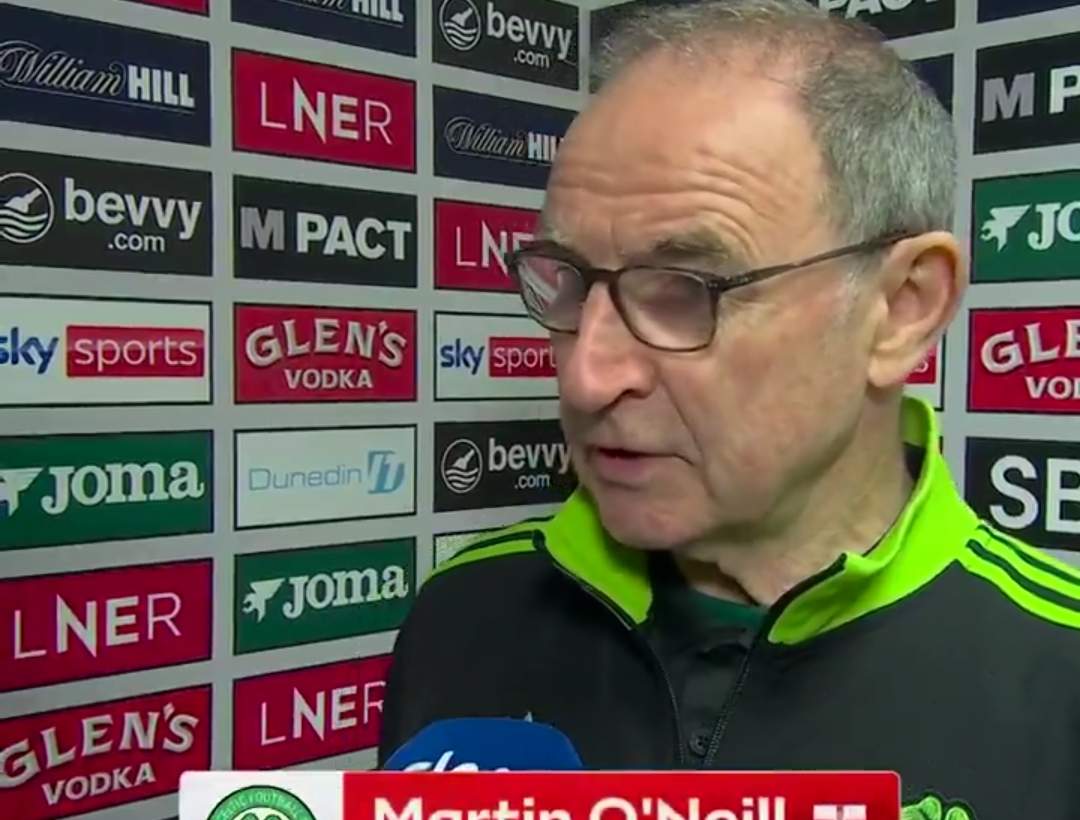
Martin O’Neill conceded there were real questions surrounding Hibernian’s equaliser after Joe Newell’s strike brought the game back to 1 1 at Easter Road.
At that point, Celtic looked firmly in charge. They were ahead and playing against ten men, but a set piece just before the interval swung the momentum.
The ball broke kindly inside the box and Newell applied the finish, but there were instant appeals for what looked like a clear handball in the build up. The decision was reviewed and ultimately allowed to stand.
That moment altered the complexion of the contest. Instead of heading into the break in front, Celtic were pegged back and forced to regroup for the second half.
O’Neill was keeping a close eye on events from the touchline and leaning on feedback from the bench during the VAR check.
He said: (TCW), “So I have the little monitor to the side, which Gavin Strachan sort of controls there, so I’m probably listening to what he’s saying as much as anything else. So, yeah, eventually, I think Gavin thought it was pretty contentious, the equalising goal, he thought that that was the case.
“Naturally, I’m pretty biased now, without even saying it, of course I agree with him, but it is what it is, whatever VAR is going to come up with, it’s going to happen.
“It worked for us in one aspect, it didn’t work the other way, and I suppose I would have probably, the truth is I probably would have a different opinion and a different answer to you had we lost the game.
“Well, I’m sure, absolutely (VAR could play a big role in the title run-in).
“I thought, way back when it was introduced for the World Cup in 2018, I thought it was a really good thing. Even now, what, six or seven years on, I really don’t know, I genuinely don’t know whether it’s a good thing or a bad thing.
“What I think it has done is stop referees from refereeing properly, I think, in the game. But I think that was going to be a natural thing eventually in the course of time.”
The episode will only fuel the ongoing debate around VAR in Scotland. In this instance, Celtic had earlier benefited when Maeda’s goal was given after review, but felt hard done by at the other end.
That balance is central to O’Neill’s argument. Decisions may even themselves out across the course of a game, but each one still carries significant weight, particularly at this stage of the campaign.
For Celtic, the bigger concern was how the goal developed. A free kick conceded in a wide position, followed by a failure to properly clear the danger.
That is something within their own control. Even with the doubts over the finish, the situation could have been dealt with earlier in the move.
With three matches remaining and the title race finely poised, moments like that will continue to be placed under the spotlight.