 Nafisa
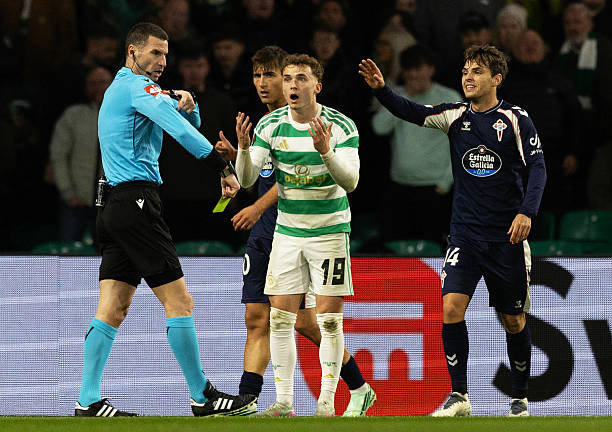
Celtic supporters have been left questioning a crucial refereeing decision after their Europa League defeat to Celta Vigo, with a first-half incident involving Callum Osmand sparking a furious debate over whether the Hoops should have been awarded a penalty.
Martin O’Neill’s side desperately needed a positive result at Parkhead after losing their opening two Europa League matches against Ferencváros and Benfica. The pressure was already mounting, and another disappointing European night was the last thing Celtic needed.
But before the game unravelled in the second half, Celtic believed they had been denied a significant opportunity to take control of the contest.
Osmand went down following contact from Celta Vigo defender Javi Rueda as he advanced towards the penalty area. Celtic appealed for a penalty, but referee Georgi Kabakov waved play on, leaving the home side frustrated.
The decision immediately attracted criticism from former Celtic players and pundits, who questioned why the officials had allowed play to continue.
However, there is an important detail in the incident that helps explain why the referee may not have pointed to the spot.
Why was Celtic’s penalty appeal rejected?
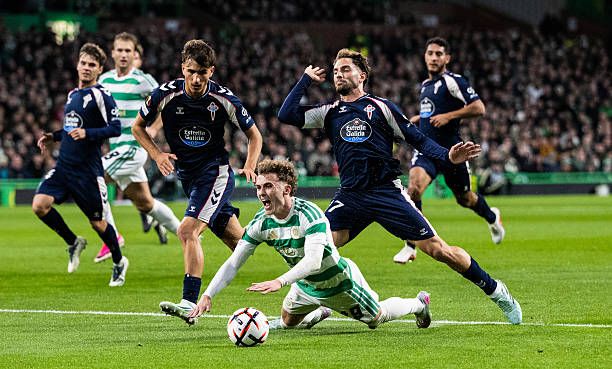
The crucial question is where the alleged foul occurred.
Contact between Rueda and Osmand appeared to begin outside the penalty area as the Celtic forward attempted to get past the defender. That distinction matters because a foul does not automatically become a penalty simply because the attacking player subsequently falls inside the box.
UEFA’ VERDICT: Under the Laws of the Game, if a direct-free-kick offence occurs outside the penalty area, the normal punishment is a free-kick rather than a penalty.
The referee must judge whether an offence took place and where it occurred. If he believes the contact was outside the area, he cannot award a penalty simply because the attacker was heading towards goal or ended up falling inside the box.
However, that does not necessarily mean the decision to wave play on was correct.
If Rueda committed a foul outside the area, Celtic could still have been entitled to a dangerous free-kick. The controversy is therefore not only about whether the incident warranted a penalty, but also whether the referee should have penalised the defender at all.
That distinction has become central to the debate surrounding the decision.
Stiliyan Petrov and Neil Lennon question the decision:
Former Celtic midfielder Stiliyan Petrov was among those who criticised the officials after watching the incident.
Speaking on TNT Sports, Petrov questioned the referee’s experience and the consistency of UEFA’s appointments before turning his attention to the challenge itself.
He said: “I don’t know what UEFA are looking into (when they pick referees) but you need to have the consistency to make a decision.
“(The foul) is probably outside the box but can they even look at it being a red card? Osmand is going through and I think it’s a really, really poor decision.”
Petrov’s comments highlighted the possibility that the incident might have warranted a different punishment even if it did not qualify as a penalty.
Former Celtic manager Neil Lennon was equally frustrated by the decision.
He said: “That is beyond me that (why it’s not a penalty). It’s either a foul outside the box or a penalty.
“Why does he (Osmand) go down? He doesn’t need to. He is going straight into the box and there is definitely contact, we can see it from up here in the gantry. I don’t know what the referee is seeing. Any touch at all can bring you down sometimes as you lose balance.”
Hearts defender Craig Halkett also questioned whether Rueda had escaped punishment for the challenge.
He said: “He (the defender) was obviously trying to put Osmand off but I think there was more than a little bit of contact there.
“You can see the push when Osmand is running through on goal. He has no other reason to go down so I think the defender is really lucky to get away with that.”
The comments demonstrate why the incident attracted such attention, although the pundits’ criticism does not itself establish that the referee made an incorrect decision.
Celtic left with more questions after another European defeat
The penalty controversy became another frustrating chapter in a night that ultimately ended in disappointment for O’Neill’s side.
Celtic later took the lead through Mika Baur, but their advantage disappeared when Javi Rodriguez equalised from a free-kick. Rodriguez then scored again shortly afterwards, condemning the hosts to a 2-1 defeat.
The Hoops have now lost their opening three Europa League matches against Ferencváros, Benfica and Celta Vigo, leaving their hopes of reaching the knockout stages under serious pressure.
O’Neill has also expressed frustration over a separate refereeing incident involving Camilo Duran shortly before Celta Vigo’s equaliser, insisting that Celtic should have been awarded a foul.
Nevertheless, the Osmand incident raises a specific question: even if a penalty was not the correct decision because the contact began outside the area, should Celtic have received a free-kick instead?
That is the distinction at the heart of the controversy. The available reports suggest that a free-kick may have been the more appropriate outcome if the referee judged Rueda had committed a foul outside the box. Whether the challenge should have been penalised at all remains the disputed issue.
For Celtic, the frustration will be compounded by their European predicament. After three consecutive defeats, they can ill afford more nights in which key moments appear to go against them — particularly when their own performances have left them with so little room for error.

 Nafisa