
 Nafisa
Hearts manager Wouter Vrancken has sparked fresh debate after delivering a brutally critical assessment of his players following their humiliating defeat at Celtic Park, with his post-match explanation raising questions about whether he fully appreciated the scale of Celtic’s performance.
The Jambos arrived in Glasgow hoping to prove they could compete with the Scottish Premiership’s strongest sides, but instead endured a nightmare afternoon as Martin O’Neill’s men tore through their defence.
Celtic were clinical, aggressive and relentless, leaving Hearts chasing shadows for large periods of a contest that quickly spiralled out of control.
The damage was already severe by half-time, with Celtic establishing a commanding 5-1 advantage before adding further goals after the break. It was a devastating result for a Hearts side with ambitions of challenging at the top of the table, and one that left their supporters searching for explanations.
Yet it was Vrancken’s reaction afterwards that could prove just as controversial as the result itself. Rather than offering an unqualified acknowledgement of Celtic’s superiority on the day, the Hearts boss concentrated heavily on his own players’ individual mistakes, prompting questions about whether his analysis told the full story of the defeat.
Vrancken points the finger at his own players
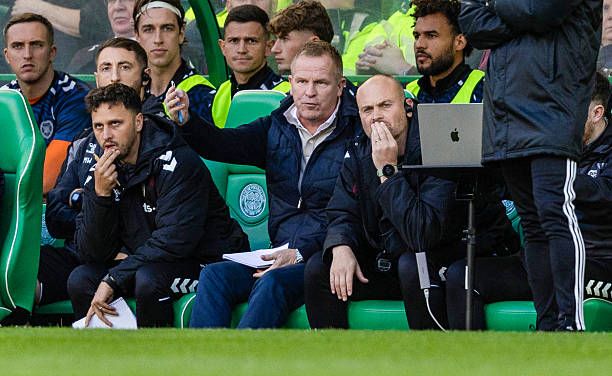
The Belgian manager did not attempt to disguise his disappointment, arguing that Hearts had effectively made life too easy for Celtic by repeatedly giving away possession and allowing the hosts to exploit dangerous situations.
Explaining how the match unravelled, Vrancken said: “The game is pretty easy to analyse, actually, because I think we started well in the game, in possession, the first minutes.
“But when you have, I think, in the first seventh and fifteenth minute or something, a set play against, and then you’re 2-0 down, then it’s difficult.
“The mindset and the confidence in the group changed, maybe, because what you see afterwards is trying to play football.
“Sometimes it worked, but the goals, I think when I look back at it, I think it’s all individual mistakes. Losing the ball too easily, stuff like that.
“Then it’s difficult to win a game overall, and especially a top game, of course.”
Those comments placed the emphasis firmly on Hearts’ execution, with Vrancken suggesting that individual errors were at the heart of the collapse.
There is little doubt that defensive mistakes contributed to the scoreline. Celtic repeatedly punished loose possession and exploited the spaces left behind by their opponents. However, the scale of the defeat also raises questions about Hearts’ overall approach and whether their tactical plan was capable of containing Celtic once the hosts found their rhythm.
For Celtic supporters, that distinction matters. Their team did not simply benefit from a few isolated errors; they produced an aggressive attacking performance, moved the ball quickly and repeatedly created situations in which Hearts were unable to cope.
The Celtic verdict that supporters wanted to hear

Vrancken’s explanation may have been intended to protect his players from losing confidence, but his reluctance to focus more directly on Celtic’s performance could leave some observers questioning his assessment.
The Hearts boss acknowledged that his side had made too many mistakes, yet his comments offered little explicit recognition of how effectively Celtic exploited those weaknesses or how thoroughly O’Neill’s team controlled the contest.
Celtic’s attacking threat had been a major talking point before kick-off, particularly their ability to turn turnovers into immediate goalscoring opportunities. Vrancken even admitted that his team had prepared for that specific danger.
He said: “Yeah, for sure. The result disappoints me the most, and the players who make individual mistakes, they know it, of course.
“The thing now is, after the game, because what happened, happened, for me it’s the most important to get in their heads that they’re not losing the confidence in what they’re doing.
“Because I’d rather have players who dare to make mistakes, maybe, and are showing confidence instead of hiding yourself, because it doesn’t bring anything to the team.”
That defence of his players is understandable. A manager cannot allow one disastrous result to destroy a squad’s confidence, particularly during a demanding campaign.
However, protecting players and acknowledging tactical shortcomings are not mutually exclusive. Hearts could have made individual errors while Celtic’s pressing, movement and attacking quality also exposed serious problems in the visitors’ game plan.
The argument is not that Vrancken was wrong to criticise his players. It is that concentrating almost entirely on their mistakes risks overlooking the quality of the opposition and the possibility that his own tactical decisions were comprehensively beaten.
Hearts knew the danger — but Celtic punished them anyway
Vrancken’s most revealing comments concerned Celtic’s threat in transition, an area he admitted had been discussed before the match.
He said: “But when it’s a mistake, then it’s maybe one or two in a whole game altogether.
“Now, when you see the goals back, it was all… And we know that they’re really strong in transition moments. We focused also on this before the game.
“They’re the best team in transition, shots at goal after transition moments.
“And when you lose the ball too easily like this, then you give them these transition moments and you’re exposed. So then it’s easy for them.”
That admission is significant. Hearts understood what Celtic could do when possession was lost, yet they were repeatedly caught in situations that allowed the hosts to attack at speed.
Celtic deserve credit for turning those opportunities into goals, and their ability to punish mistakes was a major reason the scoreline became so extraordinary. A team does not win 7-1 simply because its opponent makes errors; it must also possess the quality and ruthlessness to exploit them.
That is why some may regard Vrancken’s explanation as incomplete. His analysis identified the mistakes, but it did not fully acknowledge that Celtic’s performance helped create the conditions in which those mistakes became so costly.
Vrancken apologises to Hearts fans after Parkhead nightmare

The travelling Hearts supporters began heading towards the exits after Callum Osmand scored Celtic’s third goal, with the contest already slipping away from the visitors.
Vrancken recognised their disappointment, particularly after they had backed the team during its European commitments and travelled to Glasgow believing their side could produce a positive result.
He said: “It’s disappointing for them as well because they supported us already in Graz.
“This was the first game with their full support, and they came here with a lot of belief and trust in us. This performance and this result, especially the result itself, are disappointing for them too.”
Ultimately, Vrancken’s priority will be to ensure Hearts recover from the humiliation rather than allowing the result to derail their season.
But the post-match debate is unlikely to disappear immediately. Celtic delivered a commanding performance, punished Hearts’ weaknesses and deserved the victory on the day. Vrancken was entitled to criticise his players, but his analysis also leaves a legitimate question hanging over the Hearts boss: did he fully acknowledge how comprehensively Celtic outplayed his team, or did he place too much of the blame on individual errors while overlooking his own tactical shortcomings?


 Nafisa