 Nafisa
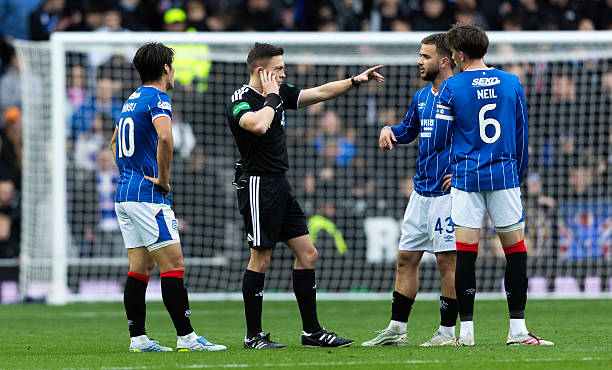
Rangers’ 3-1 victory over Kilmarnock has been overshadowed by a contentious moment involving Kevin Kelsy, with former Scotland international James McFadden explaining why VAR could not overturn the decision despite Neil McCann’s furious reaction.
The Ibrox side were already leading when the Venezuelan striker found himself at the centre of a handball controversy that left Kilmarnock questioning how the goal was allowed to stand.
Several angles appeared to show the Rangers forward making contact with the ball using his hand during the build-up, prompting immediate debate over whether referee Matthew MacDermid should have ruled out the strike.
McCann was left particularly frustrated after watching his team concede three goals before half-time, and he made no secret of his belief that Kelsy had handled the ball. But while the Kilmarnock boss questioned the decision, McFadden offered an explanation for why the officials may have been unable to intervene.
The former Scotland international acknowledged that a handball was possible, but argued that the available footage did not provide the definitive evidence required to overturn the on-field decision. That distinction is crucial: suspicion alone is not enough for VAR to recommend that a referee reverse a decision.
With Rangers collecting another three points and moving to the top of the Scottish Premiership overnight, the controversy has added an unwanted talking point to an otherwise successful afternoon for the hosts.
With Rangers already 1-0 ahead, Kelsy became involved in the decisive incident after Dan Neil delivered a cross towards the edge of the penalty area.
The £9million summer recruit attempted to bring the ball under control but stumbled and fell to the ground as he tried to establish possession. As he lifted himself back up, some camera angles appeared to show the ball making contact with his hand.
Kelsy subsequently regained his footing, set himself and unleashed a shot towards goal. The effort took a deflection and travelled beyond Kilmarnock goalkeeper Calum Ferrie, leaving the visitors furious that the strike had been allowed to stand.
MacDermid did not penalise the Rangers forward, and the decision was not overturned following a VAR review involving Grant Irvine and the video officials.
For Kilmarnock, the timing was particularly damaging. Rangers were already in front, and the second goal helped the hosts establish greater control over a contest that would become increasingly difficult for the visitors to rescue.
McFadden explains why VAR could not intervene
The incident was discussed on BBC Sportscene after the final whistle, with former Rangers striker Steven Thompson questioning whether the footage showed a handball.
“A handball? No?”
McFadden then offered his assessment, recognising why McCann was unhappy while explaining the difficulty of reaching a definitive conclusion from the available angles.
“Neil McCann is unhappy. He feels it’s a handball. It could be, but there is no definitive proof to tell you that it is. So, there is no way that it can be given.”
McFadden’s comments did not establish that Kelsy definitely handled the ball, nor did they prove that the referee’s decision was correct. Instead, his argument centred on the level of evidence available to VAR when assessing a potentially decisive incident.
Under the VAR protocol, officials are expected to intervene in relevant decisions when the review identifies a clear and obvious error, subject to the specific rules governing the incident. If the footage does not establish that an offence occurred, the on-field decision can stand.
That is the distinction McFadden was highlighting. Although some angles appeared suspicious, he believed there was insufficient definitive evidence to justify overturning MacDermid’s original decision.
The controversy is therefore not simply a question of whether the ball may have touched Kelsy’s hand. It is also about whether the footage provided enough certainty for VAR to recommend that the referee disallow the goal.
McCann makes his frustration clear
The Kilmarnock manager was far from satisfied with how the match unfolded, and his post-match comments revealed the extent of his frustration.
“We gifted Rangers three goals. I’ve got a real probelm with the second one – I think it’s a handball.
“We gave Rangers a 3-0 lead but there was still lots we did well in the first half.
“At 2-0, you’ve got two gilt-edged opportunities and we haven’t worked the goalkeeper. At half-time, I had a few words to the team and we’ve come out and dominated the game.”
McCann’s assessment contained two separate criticisms. He believed Kelsy’s goal should have been ruled out, but he also acknowledged that Kilmarnock had failed to take their own opportunities and made mistakes that allowed Rangers to build an imposing lead.
The visitors had chances to make the scoreline more competitive before the interval but failed to test Ferrie sufficiently. Once Rangers had established a three-goal advantage, Kilmarnock faced a significant challenge to get back into the contest.
Nevertheless, McCann was encouraged by the response after the break and insisted that his players needed to show the same courage from the opening whistle.
“Rangers are a good team and I knew it would be difficult but I want us to play with the bravery we showed in the second half from the start.
“It’s not good enough to just win the second half. They have to believe in how good they can be. At 3-0 at Ibrox, it’s easy to go under and they never did.”
The Kilmarnock boss also pointed to the disruption caused by the international break, although he refused to use it as an excuse for the result.
“It’s very early in the season and the long international break has disrupted our rhythm. We need to start winning games of football and I believe we will.”
Rangers take the points as controversy continues
Rangers ultimately secured a 3-1 victory, with Kelsy’s goal forming a central part of the post-match debate. The result extended their winning run and moved them to the top of the Scottish Premiership table overnight.
For Kilmarnock, the defeat brought frustration over the handball incident, missed opportunities and the three goals conceded before half-time.
McFadden’s explanation offers a possible reason why VAR did not recommend overturning the goal: the footage, in his view, did not provide definitive proof of an offence. But that is an assessment of the evidence, not confirmation that Kelsy handled the ball or that the officials were beyond criticism.
What remains clear is that McCann believed the goal should not have stood, while the VAR team ultimately allowed the referee’s decision to stand. The disagreement has ensured that Rangers’ comfortable victory will be remembered not only for the result, but also for the contentious moment that helped shape it.


 Nafisa