 Nafisa
Rangers may have left Falkirk with another important victory on Wednesday night, but one incident inside their own penalty area had the home supporters convinced they had been denied a golden opportunity.
Derek McInnes’ side were already ahead when the controversy unfolded at Falkirk Stadium, with the hosts looking for a way back into a game that would ultimately remain just one goal apart.
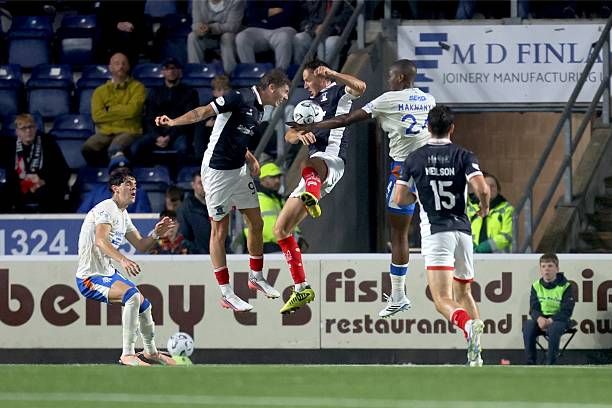
The incident came around the half-hour mark and involved summer signing Olwethu Makhanya, who found himself at the centre of attention after the ball appeared to strike his hand — not once, but twice in the space of a few seconds.
From the stands, the appeals were immediate and emphatic. Falkirk supporters believed they had seen enough to warrant a penalty, particularly with the second contact coming after a close-range attempt.
Yet the officials were unmoved, and Rangers eventually held on to secure a 2-1 victory in Westfield.
Lawrence Shankland proved decisive at both ends of the interval, scoring either side of half-time to ensure McInnes’ team returned to Glasgow with all three points.
But should Falkirk have been awarded a penalty for the Makhanya incident?
The debate quickly centred on whether the South African defender had actually committed an offence, rather than simply whether the ball had made contact with his arm.
During commentary, Chris Sutton suggested it would have been harsh for Makhanya to be punished, while former Premier League referee Keith Hackett went further by praising Steven McLean and the VAR team for the way they handled the situation.
The on-field referee immediately waved away the appeals despite the strong reaction from the Falkirk support.
VAR subsequently checked the incident but did not deem it necessary to send McLean to the monitor, meaning the original decision stood.
Hackett believes that was exactly the right outcome.
Speaking to Ibrox News, Hackett said, “The law on handball states it’s an offence if a player: deliberately touches the ball with their hand/arm, for example, moving the hand/arm towards the ball, touches the ball with their hand/arm when it has made their body unnaturally bigger.
“When you examine this incident, the referee and VAR have made the correct judgement in that while the ball does strike the hand/arm of the player, it’s clearly not a deliberate action.
“The short distance between the player who last played the ball doesn’t allow the player to withdraw his hand/arm to avoid striking it. Correct decision by the officials.”
The explanation provides an important distinction in a situation that could easily look different depending on the angle from which it is viewed.
Contact between the ball and a player’s arm does not automatically constitute a handball offence. The circumstances surrounding the contact, including the player’s movement, distance and whether the action made the body unnaturally bigger, all have to be considered.
From Rangers’ perspective, the decision was particularly significant because Falkirk were still within touching distance at that stage.
What Derek McInnes can learn from win vs Falkirk:
For all the positives Rangers can take from another victory, McInnes will know there remains plenty to improve upon.
The result continued the gradual signs of progress in attack, with Shankland once again demonstrating why Rangers invested their trust in him to lead the line. The Gers have looked increasingly dangerous in the final third, and that is an encouraging development for a team that has brought several new attacking options into the squad.
Defensively, however, the warning signs remain.
Rangers have kept just two clean sheets in their opening nine games of the season, highlighting an issue McInnes will need to address if his side are to challenge consistently across the campaign.
There have also been concerns surrounding Emmanuel Fernandez, who has struggled to reach his best level under the new manager.
The Falkirk game therefore offered another reminder that Rangers cannot afford to become complacent simply because results are beginning to improve.
The attacking department is slowly starting to click, but McInnes will need to find the right balance as the new arrivals become more integrated into the team.
The Makhanya handball controversy may have dominated one particular passage of Wednesday’s match, but the bigger picture for Rangers is clear: the three points matter, yet there is still work to do before McInnes can consider his side a genuinely settled team.

 Nafisa