 Nafisa
Rangers’ emphatic victory over St Johnstone was overshadowed by a controversial moment that has continued to generate debate, with one challenge prompting an intervention from VAR and leaving a visiting player furious at the decision.
The incident came during the second half at Ibrox, when Rangers were already in control of the match and seemingly cruising towards another important Premiership victory.
However, the decision to dismiss a St Johnstone attacker became a major talking point, particularly after the referee initially allowed play to continue without producing a red card.
Questions quickly followed about whether the dismissal was justified, with the player insisting through his reactions that he had done nothing worthy of such punishment. The involvement of VAR only added to the scrutiny surrounding the decision.
Amid the debate and reported backlash from Celtic supporters questioning the officiating, former FIFA referee Keith Hackett has now delivered his verdict on the incident, explaining precisely why the challenge warranted a red card in his opinion.
Importantly, there is no evidence in the supplied report that referee Chris Graham was bribed or that the decision was made to favour Rangers. The available explanation instead focuses on the nature of the challenge and the contact made with the opponent.
VAR intervention leads to St Johnstone sending-off
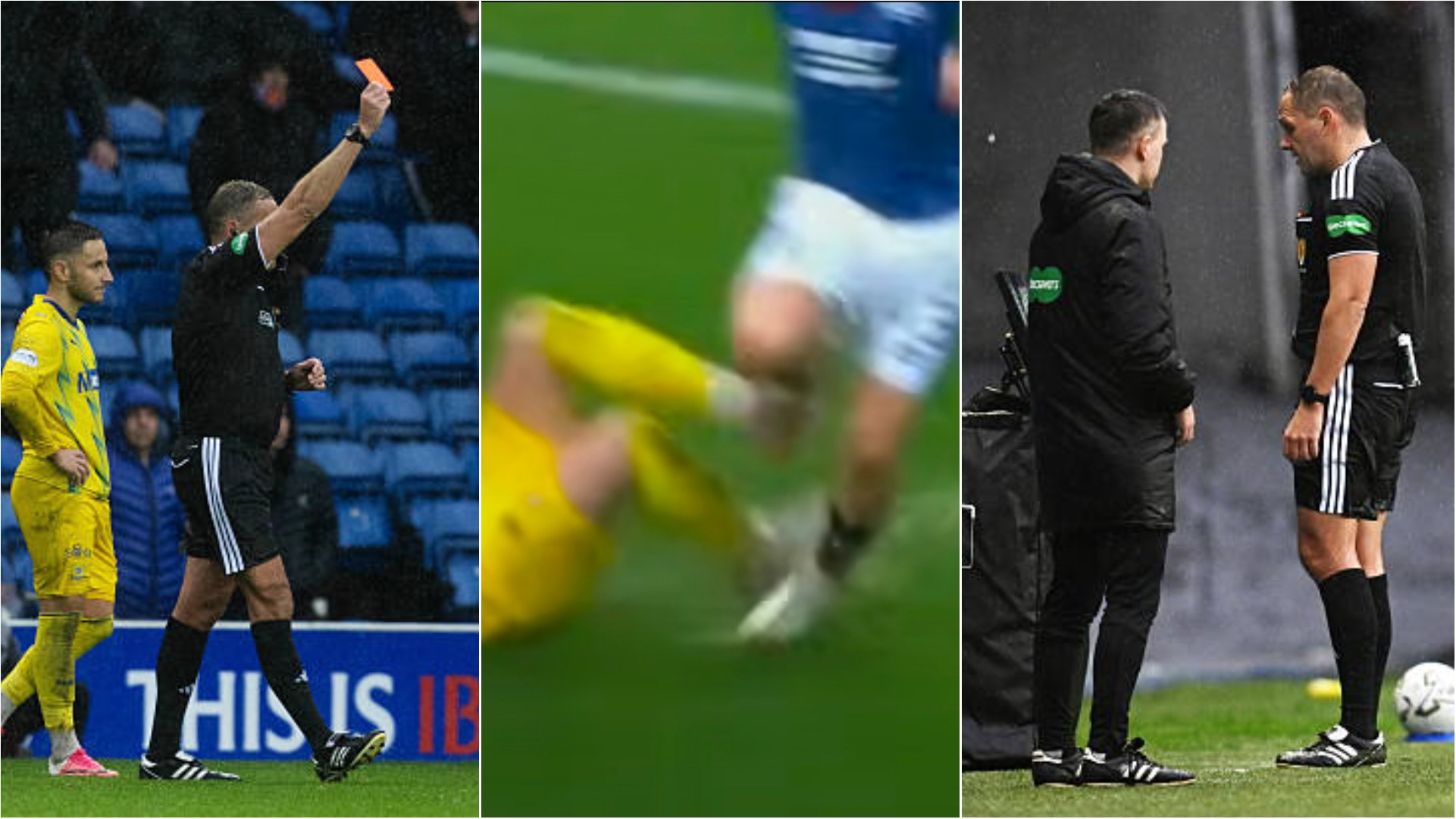
The incident occurred in the 74th minute of Rangers’ 4-0 victory over St Johnstone on Saturday afternoon, with Simo Valakari’s side reduced to 10 men after Kai Fotheringham’s challenge on Nicolas Raskin.
Rangers were already three goals ahead following Kevin Kelsy’s second goal of the afternoon, with the home side enjoying a comfortable advantage in the pouring rain at Ibrox.
Fotheringham attempted to win the ball from Raskin with a sliding challenge. Although the St Johnstone forward appeared to make contact with the ball first, his follow-through also brought his boot into contact with the Belgian midfielder’s lower leg.
Chris Graham was initially not convinced that the challenge warranted a sending-off. However, VAR official Andrew Dallas intervened, prompting the referee to review the incident.
After examining the footage, Graham changed his initial decision and showed Fotheringham a straight red card.
The 23-year-old was visibly unhappy with the outcome and protested his innocence before and after leaving the pitch. Nevertheless, the decision stood, leaving St Johnstone to complete the closing stages with 10 players.
The dismissal became one of the game’s defining talking points, even though Rangers had already established a commanding lead.
Former FIFA referee explains why the red card was justified
Keith Hackett, the former FIFA official, has now explained why he believes Graham reached the correct decision after reviewing the footage.
Speaking to Ibrox News, Hackett highlighted the height of Fotheringham’s boot, the contact with Raskin’s leg and the player’s lack of control during the challenge.
He said:
“The referee has judged that the action of the player is serious foul play. He has judged this on the contact of the player’s boot high on his opponent’s leg.
“The player, in clearly wet conditions on his backside, is out of control. Makes contact with the ball and then the player’s leg
“The fact that he made contact with the ball is frankly immaterial. Despite the claims of the player, the referee is left with no option but to issue a red card. Correct decision”
Hackett’s assessment centres on a crucial point in football’s disciplinary rules: touching the ball first does not automatically make a challenge legal.
A tackle can still constitute serious foul play if the manner of the challenge endangers an opponent or involves excessive force. In Hackett’s view, Fotheringham’s follow-through and the high contact with Raskin’s leg justified the dismissal.
That explanation provides a clear account of why Graham changed his mind after consulting VAR. Rather than the decision being based simply on whether Fotheringham won the ball, the key consideration was what happened immediately afterwards.
However, Hackett’s comments represent his assessment of the incident; they do not establish anything about the separate allegations of bribery circulating among some supporters.


 Nafisa