 Nafisa
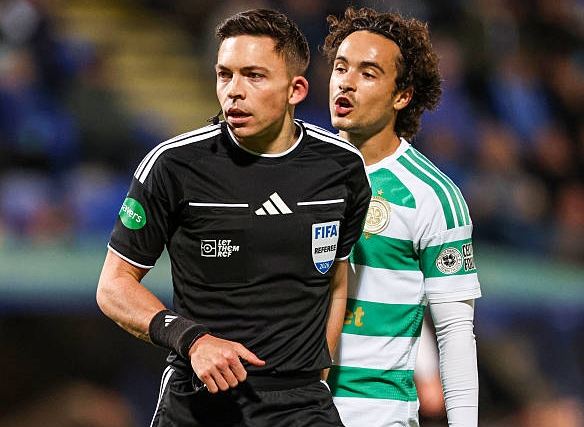
Celtic were left frustrated at McDiarmid Park after being denied a second goal against St Johnstone despite VAR having no definitive evidence that the ball had actually crossed the byline.
Martin O’Neill’s side were already 1-0 ahead when Haissem Hassan appeared to double their advantage from close range. The winger reacted quickest after Kasper Høgh headed Sebastian Tounekti’s delivery back across the face of goal, finishing from close range to seemingly put Celtic firmly in control.
However, the goal was immediately ruled out.
The officials on the pitch decided the ball had gone out of play before Høgh made contact with it, bringing the move to an abrupt end and leaving Celtic with a nervous wait while VAR reviewed the incident.
Yet the review did little to settle the argument.
Sky Sports commentator Ian Crocker explained: “Because the ball went out of the camera frame, VAR had to stick with the on-field decision.”
That is where the frustration surrounding the decision begins.
The available footage did not conclusively show the entire ball crossing the byline. Instead, the crucial moment disappeared outside the camera frame, leaving VAR without the evidence needed to overturn the original decision.
Celtic therefore lost a goal despite the review system being unable to establish with certainty that the ball had gone out.
VAR was not able to prove the on-field decision was wrong, but equally, the technology could not provide definitive evidence that the decision was right.
That distinction is likely to fuel plenty of debate among Celtic supporters.
The purpose of a VAR review is to correct clear errors when the available evidence allows officials to do so. In this case, however, the decisive piece of evidence simply was not there.
There is no suggestion that the ball definitely remained in play.
But there is also no conclusive footage demonstrating that the whole ball crossed the line.
That leaves Celtic with a particularly awkward situation: the on-field decision effectively became final because the technology could not provide enough evidence to change it.
The incident is made even more frustrating by what happened during Celtic’s previous match against St Mirren.
Shim Mheuka had a late goal ruled out in Paisley after VAR became involved in an incident where there were also problems surrounding the usual offside technology.
On that occasion, the original on-field decision was not simply treated as untouchable.
Four days later, Celtic found themselves on the other side of the argument.
At McDiarmid Park, the issue was not necessarily that VAR made the wrong call. Rather, it was that the technology was unable to provide a definitive answer at the crucial moment, yet the original decision still meant Celtic’s goal disappeared from the scoreboard.
That naturally raises an uncomfortable question about the limits of the system.
How can a goal be removed when the review itself cannot definitively establish that the offence leading to its disallowance actually occurred?
There is an important distinction between saying VAR proved the goal should have stood and saying VAR failed to prove the ball was out.
The former cannot be established from the footage.
The latter is precisely what caused the controversy.
Celtic were ultimately able to leave Perth with all three points anyway, thanks to Mika Baur’s first goal for the club.
The midfielder broke the deadlock in the second half, converting from close range after Haissem Hassan delivered the ball into a dangerous position.
That meant the disallowed goal did not change the final result, with Celtic still maintaining their perfect start to the Premiership campaign.
But the outcome does not necessarily remove the wider concern.
For Celtic, the frustration is that another goal has disappeared from a match following a VAR intervention without the available technology providing a definitive picture of what happened.
Two Celtic goals have now been ruled out within four days in situations where the technology has failed to provide a completely clear answer.
And while neither incident ultimately prevented Celtic from taking maximum points, the recurring question will be whether VAR is actually resolving contentious decisions when the evidence is inconclusive — or simply giving greater weight to the original judgement when the cameras fail to capture the decisive moment.

 Nafisa