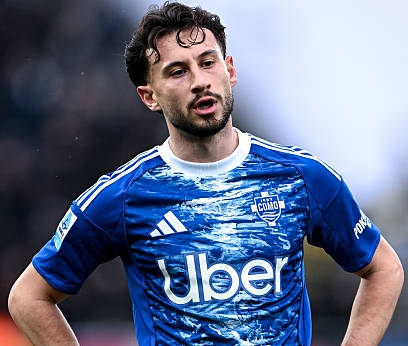
Nicolas Kühn could be on the move again just seven months after leaving Celtic, with reports suggesting Como are willing to sell the winger for around €12 million this summer.
That figure immediately stands out.
Celtic sold Kühn for £16.5 million less than a year ago, so to see his value drop so quickly underlines how sharply things have shifted in Italy. It has not worked out as Como would have hoped, despite their heavy investment and ambition to build a side capable of pushing further up the table.
For Celtic supporters, it inevitably raises a familiar question. When a player departs and struggles elsewhere, the idea of a return tends to resurface. It is not a new concept. There have been instances in the past where players have come back to Glasgow and rediscovered their best form in a system that suits them.
At his best, Kühn looked comfortable at Celtic. He operated effectively in wide areas, played on the front foot and consistently looked to attack defenders early. Crucially, the structure of the team worked in his favour, with quick service into advanced positions, movement around him and space to exploit.
That is a very different environment from the one he has encountered in Italy.
In Serie A, the game is more compact and tactically demanding. Wingers are afforded far less time on the ball, while full-backs are typically more disciplined and positionally aware. Any hesitation is quickly punished, and that appears to have disrupted Kühn’s natural rhythm.
His game relies heavily on sharp decision-making and momentum. When that flow is broken, he can become less effective and drift out of matches, which has been evident during his time in Italy.
The reported price tag also changes the dynamic slightly. Twelve million euros is not insignificant, but it is lower than the fee Celtic received. In theory, that could make him a more attainable option for clubs willing to back his ability to rediscover form.
However, it would still represent a considerable investment.
Celtic are unlikely to commit that level of fee for a player whose performances have dipped over the past 12 months, particularly with a broader squad rebuild expected in the summer.
If the valuation were to fall further, the conversation would become more realistic, but it would still divide opinion among supporters.
Some would point to the qualities Kühn displayed during his time in Glasgow and argue that, in the right system, he could thrive once again. Others would question the logic of revisiting a player who has already had his opportunity, rather than identifying a new option with long-term upside.
That broader question often underpins decisions of this nature.
Returning for a former player can offer familiarity and a degree of security, but it can also raise concerns about the club’s recruitment direction. Instead of progressing and identifying the next emerging talent, it risks looking like a step backwards.
Kühn’s ability is not in doubt.
The uncertainty lies in whether a return would reignite his strengths or simply revisit a situation that has already run its course.