 Nafisa
Rangers escaped another major refereeing controversy during their Premier Sports Cup semi-final victory over Aberdeen, but the decision not to award the visitors a penalty for Dujon Sterling’s handball has raised fresh questions about what actually happened inside the VAR room.
The incident occurred inside the Rangers penalty area when Sterling failed to make contact with an incoming ball with his head, only for it to strike his forearm. Aberdeen players appealed for a penalty, but referee Ryan Lee refused to point to the spot.
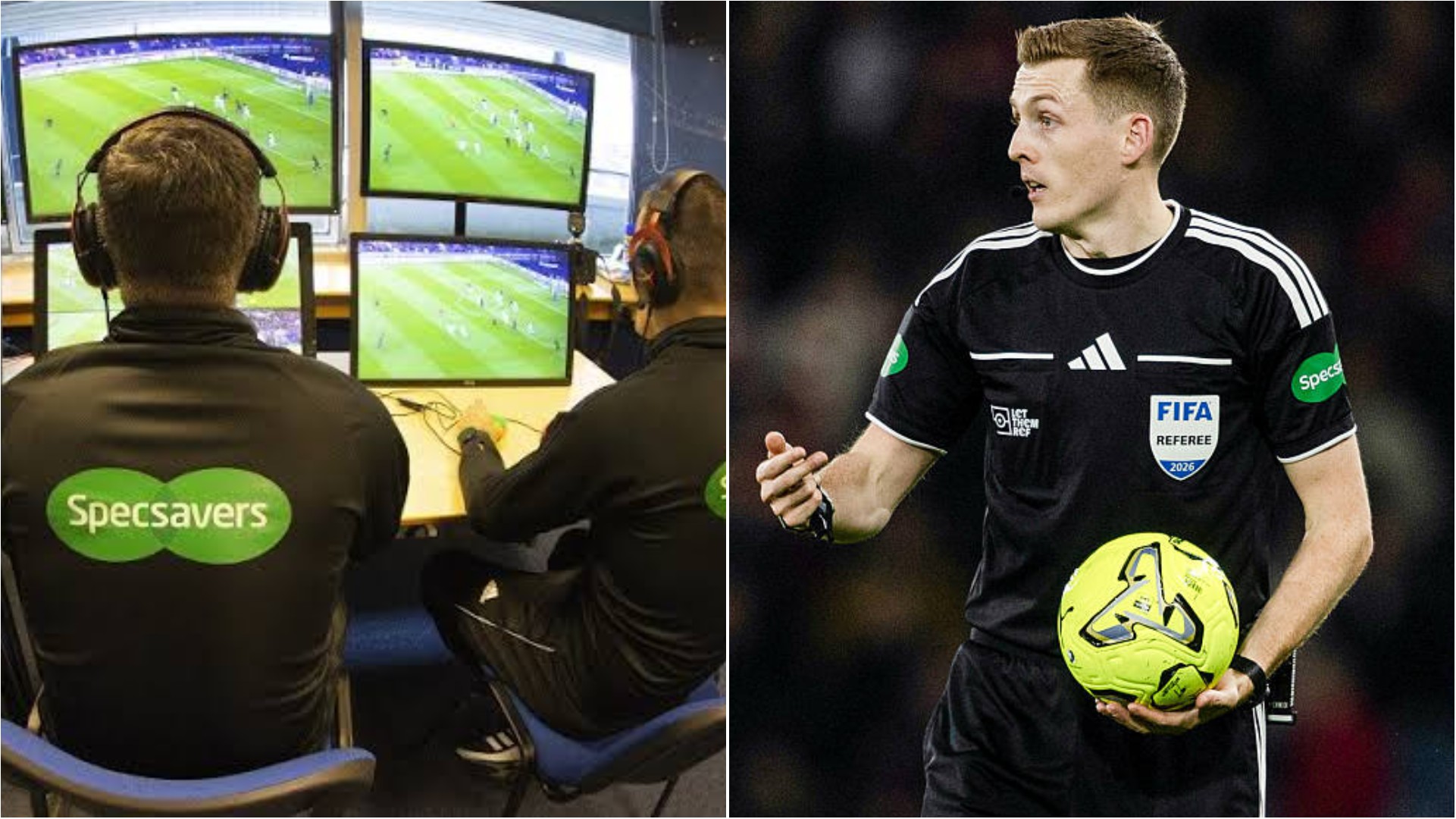
VAR official John Beaton subsequently checked the incident, but no on-field review was recommended. Rangers therefore escaped conceding a potentially crucial penalty, leaving Aberdeen to wonder how the decision had gone against them.
Former Scotland international Michael Stewart was particularly unimpressed, questioning why the officials had not awarded a spot-kick.
“It hits his forearm! He misses the ball and it hits his arm. I’ve seen a million incidents like that that have been given. He doesn’t get his head anywhere near it!”
Stewart’s reaction captured the frustration surrounding the incident, but the key question is what VAR might have seen that convinced the officials to stick with the original decision.
Although no recording or official transcript of the VAR conversation has been made public, the possible reasoning behind the decision can be reconstructed by considering the handball laws and the circumstances of the incident.
VAR may have focused on Sterling’s arm position
One possible explanation is that VAR considered Sterling’s arm to be in a natural position as he attempted to deal with the aerial ball.
Under the Laws of the Game, contact between the ball and a player’s arm is not automatically an offence. Officials must consider whether the player deliberately handled the ball or made their body unnaturally bigger by positioning their arm in a way that was not justified by their movement.
That distinction could have been central to the assessment of Sterling’s actions.
The VAR officials may have accepted that the ball struck his forearm but concluded that his arm position was consistent with the movement he was making while attempting to challenge for the ball.
In that interpretation, Sterling missing the header would not automatically turn the subsequent contact into a punishable handball.
The likely conclusion would be that the incident did not meet the threshold for a penalty.
The possible VAR conversation before the decision:
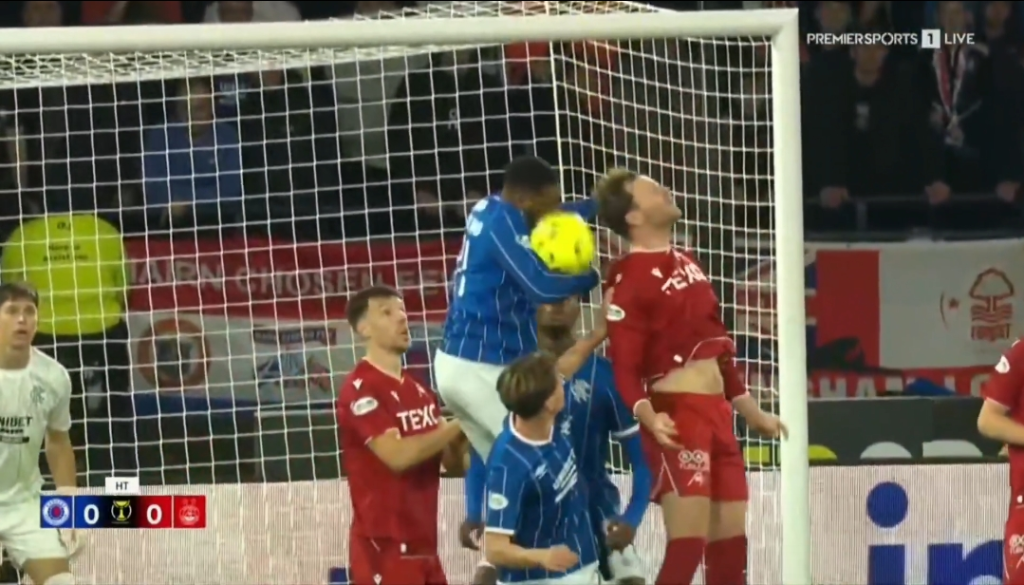
While this is not an authenticated transcript, one possible reconstruction of the conversation would be:
VAR: The ball makes contact with Sterling’s arm. We need to assess the position of his arm and whether it makes his body unnaturally bigger.
VAR: He is attempting to deal with an aerial ball, and his arm appears to be in a natural position for that movement.
VAR: There isn’t sufficient evidence of a punishable handball to recommend an on-field review.
Referee: No penalty. Play continues.
This would explain how the officials could acknowledge that the ball struck Sterling’s forearm without considering the contact sufficient to award Aberdeen a penalty.
However, it remains an interpretation of what might have happened rather than a confirmed account of the discussion between the officials.
Michael Stewart’s reaction tells a different story
Stewart’s argument centred on the fact that Sterling failed to make contact with the ball using his head before it struck his forearm.
His frustration was understandable from Aberdeen’s perspective, particularly because the ball appeared to make clear contact with the defender’s arm inside the penalty area.
The former midfielder also pointed out that he had seen similar incidents result in penalties on numerous occasions.
But the handball law does not operate on the basis of whether a defender successfully heads the ball. The crucial question is whether the arm contact itself constitutes an offence.
That is where the interpretation of Sterling’s body position becomes so important.
If his arm was considered naturally positioned during the aerial challenge, the officials could justify allowing play to continue. If it was judged to have made his body unnaturally bigger, the decision could have been very different.
Another Hampden decision Rangers survived
The Sterling incident was not the only controversial moment involving Rangers during the semi-final.
James Penrice also escaped a booking after catching Aberdeen midfielder Afeez Aremu with a dangerously high boot. Former PGMOL chief Keith Hackett subsequently described the challenge as a nailed-on red card and questioned why VAR had not intervened.
Rangers eventually won the contest 1-0 through Ryan Naderi’s 83rd-minute goal, booking their place in the Premier Sports Cup final.
However, the two incidents have left Aberdeen supporters questioning whether the officials got crucial decisions right.
In Sterling’s case, the possible explanation is that VAR considered his arm position natural and therefore found no clear basis for recommending a penalty review.
That may explain the decision, but without an official explanation or the actual VAR audio, it remains impossible to establish precisely what convinced the officials to reject Aberdeen’s appeal.


 Nafisa