 Nafisa
Celtic’s miserable week went from bad to worse at Celtic Park as Rangers secured a second Old Firm victory in the space of just eight days, leaving Martin O’Neill’s side with plenty of questions to answer.
Ryan Naderi scored the only goal of the game in the 33rd minute, reacting quickest after Viljami Sinisalo could only parry Minsu Kim’s effort into his path.
Rangers had already shown signs of being the more dangerous side before the opener, and they continued to threaten on the counter as Celtic struggled to find any real rhythm.
Celtic came close to an equaliser immediately after half-time when Colby Donovan’s header was brilliantly saved by Ivor Pandur, but Rangers remained the more convincing team.
The visitors finished with 15 shots to Celtic’s five and eight shots on target compared with Celtic’s one, while Cameron Carter-Vickers also had to produce a vital block after Djeidi Gassama hit the post.
It was another damaging result for O’Neill, coming just days after Rangers had beaten Celtic 3-0 in the League Cup at Ibrox and following the Europa League defeat to Ferencvaros.
Three defeats in three major games had suddenly turned Celtic’s previously positive start into a period of serious uncertainty.
And it was what happened after the final whistle that created another major talking point.
Carter-Vickers did not simply blame the result on poor finishing or individual mistakes. Instead, the Celtic defender admitted that the team had looked too disjointed and suggested they needed a clearer identity and a more consistent tactical message.
Speaking to Sky Sports, Carter-Vickers said Celtic had played “a bit too random” and needed to get better at having a “script and sticking to it.”
He also explained that players need something to fall back on during high-pressure matches, while acknowledging that Celtic had not yet had enough time to properly develop that understanding.
“There’s a lot of new players at the club,” Carter-Vickers said, stressing the importance of getting everyone “on the same script” and finding consistency.
On the surface, it could be viewed as an honest assessment from one of Celtic’s senior players.
But the comments immediately raised eyebrows because Carter-Vickers appeared to be talking about much more than individual player performances.
He spoke about consistency of messaging, consistency of ideas and the need for Celtic to establish exactly how they wanted to operate as a team.
And that opened the door for questions about O’Neill and his coaching staff.
Carter-Vickers did make it clear that the players remained behind their manager, but his comments nevertheless suggested that Celtic’s problems were not simply down to players failing to execute their chances.
That comes at an extremely awkward time for O’Neill.
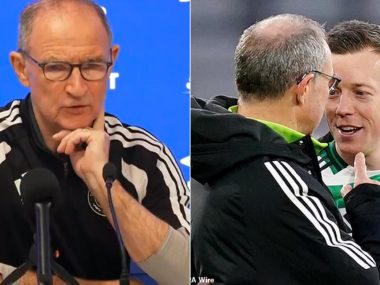
The Celtic manager had already admitted after the Rangers defeat that he needed time to reflect on his position, saying he would use the international break to consider the situation and speak with the board.
O’Neill’s comments came after a week in which Celtic had been beaten twice by Rangers and also suffered defeat to Ferencvaros. He even suggested that it might be time to “wrap it up”, leaving supporters wondering whether the 74-year-old was genuinely considering walking away from the job.
The uncertainty surrounding O’Neill has therefore become impossible to separate from the issues inside his squad.
Celtic chief executive Michael Nicholson has since backed the manager, saying the club would come together and support O’Neill following what he described as a painful week.
But Chris Sutton was not prepared to let Carter-Vickers’ comments pass without a response.
The former Celtic striker launched a remarkable attack on the defender, arguing that the senior players needed to accept more responsibility instead of publicly pointing towards the manager and coaching staff.
Sutton said he had been a huge admirer of Carter-Vickers and had regularly praised him, making his criticism even more striking.
But he described the defender’s comments as “disgraceful” and accused him of effectively “passing the buck” back to O’Neill and the coaches.
For Sutton, the problem was not that Carter-Vickers had identified tactical problems. It was that he had discussed them publicly after a derby defeat rather than dealing with them inside the dressing room.
“It was a cop-out,” Sutton argued, adding that the comments had made an already difficult situation even worse.
Sutton then took his criticism considerably further.
He argued that experienced players should be capable of making decisions for themselves during matches rather than expecting coaches to provide every answer from the touchline.
Carter-Vickers is 28 and captain Callum McGregor is 33, Sutton pointed out, arguing that neither should need to be “held by the hand” throughout a match.
His frustration was particularly clear when he invoked the Martin O’Neill of Celtic’s first spell at the club.
Sutton claimed that the O’Neill of 25 years ago would never have tolerated a player making such comments publicly, saying Carter-Vickers’ “feet wouldn’t have hit the floor.”
However, Sutton also acknowledged that O’Neill himself had contributed to the current uncertainty by openly discussing his future.
And despite his attack on Carter-Vickers, Sutton did not completely absolve the Celtic manager.
He admitted that Celtic have tactical problems and questioned whether O’Neill has been able to build the team he wanted because of issues higher up at the club and deficiencies left in the squad after the transfer window.
That makes the situation particularly complicated.
Carter-Vickers appears to believe Celtic need greater clarity and consistency from the team as a whole.
Sutton believes the players must take much more ownership themselves.
O’Neill, meanwhile, is now having to decide whether he wants to continue leading a Celtic side that has suddenly lost three consecutive matches and been comprehensively outplayed by Rangers twice in eight days.
And that is why the fallout from Carter-Vickers’ interview could prove more significant than the defender perhaps intended.
The comments have opened up a much bigger conversation about Celtic’s identity, the relationship between the players and coaching staff, and whether everyone inside the dressing room is actually working from the same plan.
For Sutton, however, there is one simple message to the Celtic players: stop looking towards the dugout for every answer and start taking responsibility themselves.
After a week that has left Celtic facing questions on almost every front, the last thing O’Neill needed was another fire to put out.
Carter-Vickers may have simply been attempting to explain why Celtic have struggled.
Sutton believes he poured petrol on the flames.

 Nafisa