 Nafisa
Celtic’s 4-0 victory over Dundee United at Tannadice has continued to dominate the conversation after one of the goals became the centre of a major VAR controversy.
What initially looked like another comfortable step forward for Martin O’Neill’s side instead became a talking point that quickly spread across Scottish football, with supporters questioning whether Celtic had benefited from an incorrect decision.
The incident came during a dominant spell for the visitors, with Celtic eventually running out convincing winners and booking their place in the next round of the Premier Sports Cup.
But the controversy surrounding the second goal refused to disappear.
Dundee United players protested immediately, while the VAR officials went through the incident before deciding that there was no reason to overturn the goal.
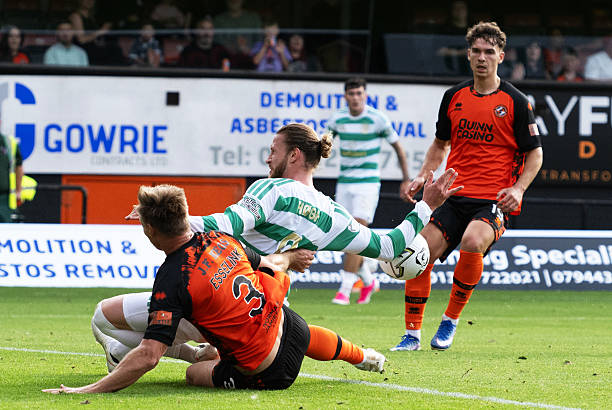
The debate intensified after replays appeared to show the ball making contact with the arm of Celtic attacker Kasper Høgh before the ball fell to Camilo Duran, who finished the move.
That detail was enough to reignite arguments over handball rules and whether the goal should have been allowed to stand.
And with comparisons quickly being made to other controversial decisions involving handball in Scottish football, some supporters began asking a much bigger question: could Celtic actually face punishment over the incident?
Celtic controversy creates huge reaction
The Tannadice match itself was far from straightforward.
Dundee United struck the woodwork five times during the contest, meaning Celtic were perhaps fortunate not to face a much more difficult evening.
Instead, O’Neill’s side punished their opponents at the other end.
Auston Trusty opened the scoring before Duran doubled Celtic’s advantage, with the latter goal producing the incident that would ultimately dominate the post-match discussion.
Sebastian Tounekti and Benjamin Nygren then added further goals as Celtic eventually secured a 4-0 victory.
The result was never seriously threatened after Celtic pulled away, but the argument over the second goal became increasingly heated.
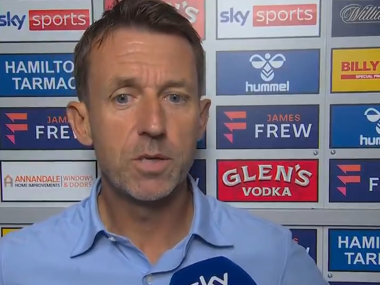
Dundee United boss Jim Goodwin was among those unhappy with the decision, while pundits also questioned the consistency of VAR’s interpretation.
The controversy was particularly significant because Scottish football has already experienced several contentious handball decisions this season.
That led to comparisons with the Falkirk incident from the opening week, with some arguing that there appeared to be similarities between the two situations.
Willie Collum forced to explain decision
The level of debate eventually prompted Willie Collum, the Scottish FA’s Head of Referees, to provide an explanation.
And this is where the situation became considerably more complicated.
Collum did not attempt to deny what the replays appeared to show.
Instead, he confirmed that the ball did indeed strike the Celtic player’s hand.
However, that did not automatically mean a foul had been committed.
According to Collum, the contact was accidental and occurred as a consequence of the player’s playing action.
The key issue was what happened immediately afterwards.
The Celtic player involved in the handball was not the player who scored the goal.
That distinction is crucial under the relevant handball law.
Collum explained that the specific provision concerning an immediate goal only applies when the player who handled the ball is subsequently the player who scores.
In this case, another Celtic attacker — Duran — finished the move.
That meant the accidental contact was not considered a punishable handball.
The Scottish FA therefore backed the decision made by the referee and VAR team.
So what has the Scottish FA decided?
Despite the huge reaction online and suggestions that Celtic could somehow face severe punishment, there is no decision to ban Celtic from the Scottish Premiership.
There is also no indication that the Scottish FA is attempting to remove Celtic from the Premier Sports Cup because of the incident.
The governing body’s response has instead been to clarify why the officials considered the goal legal.
The explanation may not satisfy everyone, particularly those who believe the decision should have been different, but the important point is that the incident has not resulted in disciplinary action against Celtic.
The club remain in the competition, their 4-0 victory stands and there is no league ban hanging over O’Neill’s side.
The Scottish FA’s position is that the officials applied the handball law correctly.
Why the debate is unlikely to disappear
That does not necessarily mean the controversy is finished.
The argument has now moved beyond whether the ball touched the Celtic player’s hand — because Collum has already acknowledged that it did.
Instead, the debate centres on whether the law is being applied consistently across different matches.
That is why the Falkirk comparison has become such a talking point.
Collum insists the incidents are different and should not be treated as identical, but critics remain unconvinced.
For Celtic, however, the immediate priority is much simpler.
They have progressed in the cup, recorded a 4-0 victory and can now turn their attention towards their next challenge.
The dramatic claims of a Celtic ban have not materialised.
The Scottish FA’s decision is effectively clear: Celtic will NOT be banned from the league, their Tannadice result stands and no punishment has been imposed over the controversial goal.
The governing body has acknowledged the handball — but insists the contact was accidental and, because a different Celtic player scored, it was not a punishable offence under the law.


 Nafisa