 Nafisa
Rangers’ 2-1 defeat to Hibernian at Ibrox has sparked another major debate over VAR after Vanja Dragojevic was penalised for his tussle with Jason Kerr inside the box.
The Light Blues were searching for their first Scottish Premiership victory of the season when the controversial incident occurred, with the score still goalless.
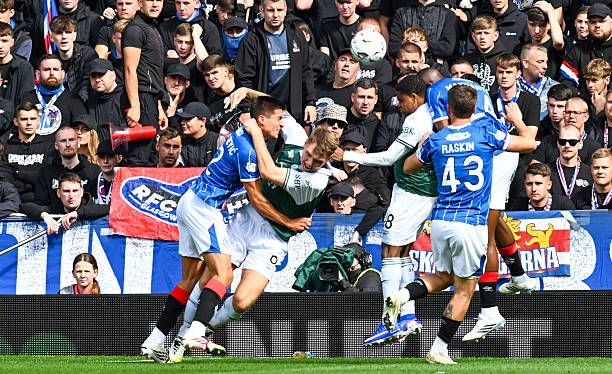
A cross was floated into the Rangers penalty area, with Dragojevic and Kerr battling for position.
At first, there appeared to be little reaction from the Hibernian players, and there was no obvious appeal for a penalty.
However, VAR intervened.
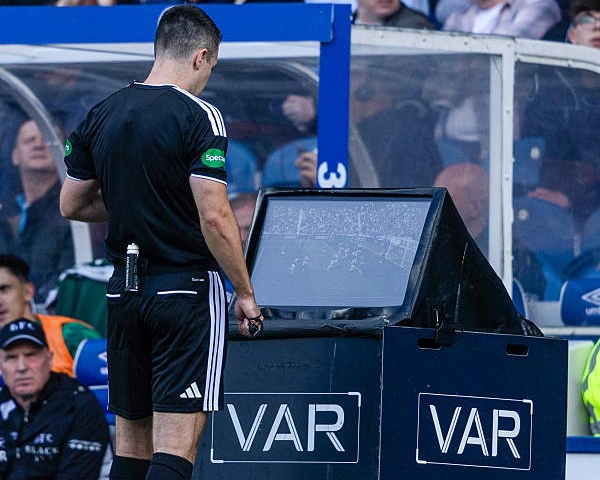
Matthew McDermid and his team instructed referee Don Robertson to review the incident on the pitchside monitor, and after taking another look, Robertson decided that Dragojevic had committed a foul.
Josh Campbell stepped up and converted the resulting penalty, giving David Gray’s side the advantage.
Rangers eventually equalised through a Miguel Chaiwa own goal, but their hopes of rescuing a point disappeared in stoppage time when Callum Wright’s deflected effort secured a dramatic 2-1 victory for Hibs.
The penalty decision has subsequently become one of the biggest talking points from the match, with several former players and referees questioning whether the incident was serious enough to warrant VAR intervention.
Alan Hutton calls penalty decision ‘soft’
Former Rangers defender Alan Hutton was among those struggling to understand why Robertson was sent to the monitor in the first place.
Speaking on Premier Sports, Hutton admitted that Dragojevic’s decision to put his hands on Kerr gave the officials something to examine, but insisted the incident appeared too minor for a penalty.
“I must admit, I didn’t think so. It looked a bit soft,” Hutton said.
He suggested that Dragojevic’s positioning may ultimately have influenced the referee because the Rangers midfielder was focused on Kerr rather than tracking the ball.
“The only thing is Dragojevic, he is not looking at the ball. It’s in flight, and he is just staring at Kerr there,” Hutton explained.
However, he also pointed out that both players were involved in the physical battle.
“They are both really as bad as each other. He has his hands on his face and there is a coming together. I thought it was a little bit soft.”
That assessment was echoed by Tony Docherty, who also believed the decision was too harsh.
Tony Docherty questions VAR intervention
Docherty accepted that Dragojevic was not watching the ball, but argued that this alone should not have been enough to turn the incident into a penalty.
“I thought it was soft,” he said.
“The only reason for it is that he is not looking at the ball.”
The former manager also highlighted Kerr’s involvement in the tussle, pointing out that the Hibs defender had his own hands on Dragojevic.
“They are both tussling. Kerr actually has his hands on his [Dragojevic’s] head.”
Docherty’s biggest frustration appeared to be with the decision to involve VAR in the first place.
“When we are watching it, we never thought it was an incident – I know that is VAR’s job, but I think they are being quite pedantic getting involved there.”
That has become a key part of the debate.
Rather than simply asking whether there was contact, the question being asked is whether the contact was clear and obvious enough to justify overturning the original decision.
Andy Halliday admits Dragojevic took a risk
Former Rangers midfielder Andy Halliday offered a slightly more balanced assessment.
He acknowledged that Dragojevic did initiate some of the contact by putting his hands on Kerr, but argued that Kerr’s actions also needed to be considered.
Asked on BBC Sportscene whether Dragojevic initiated the contact, Halliday replied:
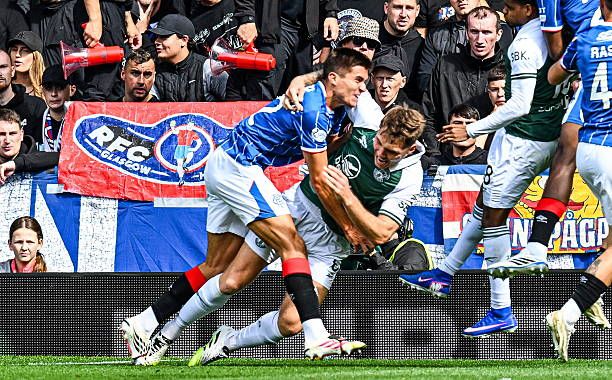
“Yes, but listen, you always run the risk when you have the hands on an opposing player.”
However, he immediately questioned whether such incidents should become the standard for awarding penalties from set pieces.
“I really hope this is not the barometer for penalties from corner kicks this season.”
Halliday pointed towards Kerr’s involvement, arguing that the Hibs defender also had his hands on the Rangers player.
“Because, yes, he has his hands on Jason Kerr but at the time it’s adjudged that the foul has been made I think it’s equally a foul both ways.”
He added:
“I mean, Jason K has his hands on Dragojevic’s face and his right arm is round his neck.”
For Halliday, that made the final decision particularly difficult to understand.
He believed Robertson should have stuck with his original judgement after reviewing the footage.
“I stress, that should never be a penalty kick. Even when Don Robertson is sent to the monitor, I like to think when he has a second look at that he will strong enough to stick with his original decision, but he has decided to give a penalty.”
Scott Brown criticises Dragojevic’s defending
Former Celtic captain Scott Brown was more critical of Dragojevic’s positioning, although he also stopped short of calling the incident a penalty.
Brown argued that the Rangers player made the situation unnecessarily difficult by allowing Kerr too much space.
“His marking is terrible. It is actually terrible. He is a yard and a half off him, and there is no body contact to start with.”
Brown believed Dragojevic could have prevented the situation simply by staying closer to his opponent.
“See if he is touch tight to him, he doesn’t get that far away from him and Jason can’t get away from him.”
Yet even after criticising the Rangers midfielder, Brown still concluded that Robertson had been too harsh.
“Look, I don’t think it’s a penalty, because if that’s a penalty then there is going to be a penalty every game.”
He accepted that Dragojevic started the contact but insisted there was not enough in it.
“100 per cent he [Dragojevic] starts it, but it’s not enough for me. There is always going to be contact in the game.”
Former referees put the blame on VAR:
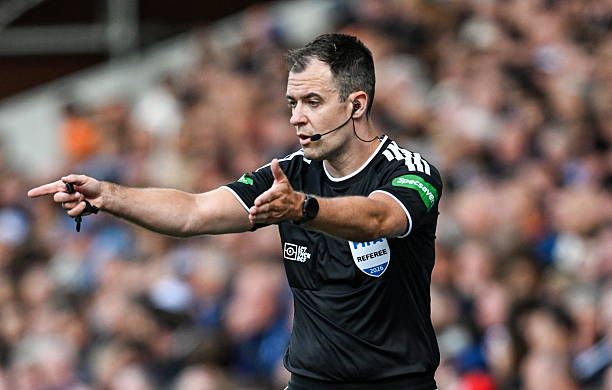
Perhaps the strongest criticism came from former referees Steve Conroy and Des Roache.
Writing through The Ref’s View podcast X account, the officials were extremely unhappy with the decision and placed the responsibility firmly on the VAR team.
“Absolutely incredible decision, both are at it. No way you can punish one and not the other.”
They argued that the incident should never have resulted in a penalty and questioned the wider implications of the decision.
“That’s all down to VAR. Could be a long season if this is what’s deemed acceptable.”
Their comments are particularly significant because they come from former officials rather than supporters or pundits with an obvious club allegiance.
Rangers left furious as controversy overshadows defeat
For Rangers, the frustration will be that the decision ultimately had a major impact on the match.
Campbell’s penalty put Hibs ahead early, forcing Derek McInnes’ side to chase the game.
Rangers did recover through Chaiwa’s own goal, but Wright’s late winner ensured that the controversial penalty would become even more significant in the aftermath.
The debate will inevitably continue over whether Dragojevic was reckless to put his hands on Kerr.
There is little doubt that the Rangers player gave Robertson something to consider.
But with Kerr also appearing to make contact with Dragojevic, several pundits and former referees believe the incident should have been treated as normal physical contact rather than a foul worthy of a spot kick.
And that is ultimately why the VAR controversy has generated so much anger.
If this is to become the standard for penalties at corners and free-kicks, defenders and attackers could be facing a very different interpretation of contact inside the box throughout the season.
For Rangers, however, the focus now has to turn back towards the bigger problem.
They have still not won a league game under McInnes, and Sunday’s defeat leaves them five points behind the early pace-setters after just two matches.
The penalty decision may have been controversial, but the Rangers manager will know his side must improve considerably if they are to challenge Celtic and Hearts at the top of the Premiership.
VAR may have played a major role in the first goal.
It cannot explain away everything that went wrong afterwards.


 Nafisa