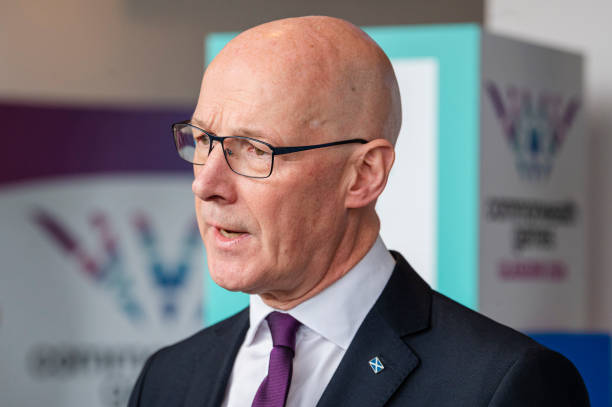
Scotland’s First Minister John Swinney has criticised Celtic and Rangers for what he believes was a delayed response to the disorder that followed last Sunday’s Scottish Cup clash at Ibrox.
The dramatic quarter-final tie, which ended with Celtic progressing after a tense penalty shoot-out, was overshadowed by chaotic scenes after the final kick. Dozens of supporters spilled onto the pitch, sparking confrontation, police intervention and widespread criticism from across Scottish football.
While the Scottish FA moved quickly to condemn the incident and later confirmed that a full review would take place, the two clubs involved did not release official statements until Thursday evening — several days after the match.
Rangers were the first to respond, “unequivocally” condemning the disorder. Celtic followed shortly after, stating that the “examples of unacceptable behaviour” seen after the match must be addressed.
For Swinney, however, the reaction came far too late.
Speaking on an upcoming episode of the BBC Scotcast series, the First Minister made his frustration clear as he addressed the timeline of events following the chaotic scenes.
‘I think it took them too long to say anything about it, bluntly,’ he stated. ‘I think we’ve got to try to bring the clubs together with the football authorities because, at a very basic level, I am not prepared to tolerate that violence at a football match.’
The incident itself has raised serious concerns about safety at one of football’s most intense rivalries.
Swinney suggested that some supporters appeared to attend the match prepared for trouble, pointing to the sight of fans wearing face coverings among sections of the crowd.
‘I think it took them too long to say anything about it, bluntly,’ he stated. ‘I think we’ve got to try to bring the clubs together with the football authorities because, at a very basic level, I am not prepared to tolerate that violence at a football match.’
‘Who needs to go to a football match wearing a balaclava? It wasn’t very cold that day,’ he added. ‘You’re going there with malicious intent. You don’t need to wear a balaclava.’
The derby match itself was already significant before the post-match scenes unfolded.
It was the first Old Firm clash played with a large travelling support since 2018, with around 7,500 away fans allowed into each stadium under Scottish Cup regulations. In league matches over recent seasons, away allocations have typically been restricted to between 2,500 and 3,000 supporters.
Before the disorder, there had been growing calls from both clubs and sections of the fanbase to restore larger away allocations for league games as well.
In the wake of what happened at Ibrox, that possibility now looks far less certain.
Swinney also revealed he remains personally cautious about attending Old Firm matches, having previously said he would not take his teenage son to one of the fixtures.
However, he stopped short of suggesting the derby should be played behind closed doors.
‘I would rather that’s not the case, but I think none of us can watch those scenes and think that there isn’t something that’s got to give as a consequence of what happened at the weekend,’ he warned.
‘I want to take time to engage… the clubs and the SFA, to identify what is the best course of action to take.’
The trouble at Ibrox began moments after Celtic secured their place in the Scottish Cup semi-finals.
Following the decisive penalty from Tomas Cvancara in the shoot-out, a number of visiting supporters ran onto the pitch to celebrate. The situation quickly escalated when Rangers fans — many from the Copland Road stand where the Union Bears ultras are located — also entered the field and moved toward the halfway line where a police cordon had formed.
Missiles were reportedly thrown during the disorder, at least one supporter was injured, and several arrests were made in the aftermath.
Police Scotland Chief Constable Jo Farrell had already criticised the silence from both clubs earlier in the week before their eventual statements were released.
She said at the time: ‘(There was) lots of coverage in the media in relation to the events of Sunday afternoon (but), when we got to Monday evening, there was still no commentary from either of those clubs in respect of the violence that was witnessed.’
With the Scottish FA now launching a full review and political pressure mounting, the fallout from the chaotic scenes at Ibrox is likely to continue long after the final whistle of that heated Scottish Cup tie.